



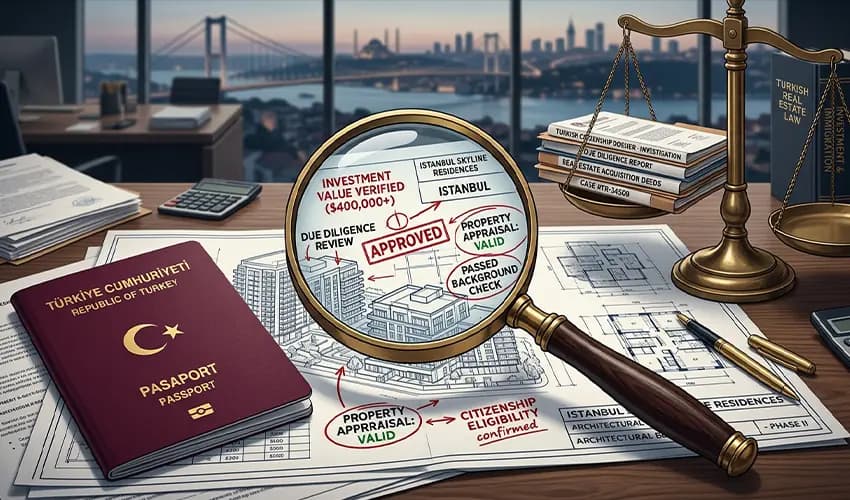
In 2026, the Turkish Citizenship by Investment (CBI) program became the focus of major regulatory and criminal investigations. Following joint reviews by various institutions, authorities launched operations and investigations throughout 2026 aimed at addressing allegations related to property valuation fraud, circular capital transfers, and illegal brokerage networks.
What happened in 2026?
During 2026, authorities including the Ministry of Interior, the Ministry of Justice, the General Directorate of Land Registry and Cadastre (TKGM), and public prosecutors conducted multiple investigations and operations.
In a major announcement in August 2026, the Ministry of Justice confirmed that legal proceedings had been initiated to revoke the citizenship of 687 individuals. These cases allegedly involved low-value properties, fabricated expert reports, and collusive transactions (muvazaalı). During these operations, authorities reported 72 detentions, the precautionary freezing of 1,045 properties, and the identification of approximately 2.5 billion TRY in capital that allegedly never genuinely entered the country.
Why are Turkish real estate citizenship cases under scrutiny?
The Turkish real estate citizenship program has undergone major statutory transformations since its inception:
2017: Launched with a minimum entry threshold of $1,000,000 USD.
September 2018: Threshold reduced to $250,000 USD.
June 2022 (Presidential Decision No. 5554): Minimum real estate threshold elevated to $400,000 USD.
This tightening created market friction. As the price threshold increased, it is alleged that some developer syndicates and brokerages sought to exploit the system by organizing schemes that claimed lower-value units fulfilled the $400,000 legal requirement.
Allegations, investigations, and final decisions
When evaluating these events, a critical legal distinction must be considered:
Police detentions, searches, and prosecutor-ordered asset freezes represent provisional criminal measures, whereas the revocation of Turkish citizenship is a completely distinct administrative procedure. An arrest or criminal probe against a real estate developer does not automatically strip an investor of citizenship. Revocation requires an independent administrative process.
What is the Turkish citizenship fraud case about?
The $400,000 statutory threshold
Under the Regulation on the Implementation of the Turkish Citizenship Law, a foreign national qualifies for exceptional citizenship by acquiring real estate worth at least $400,000 USD (or its foreign currency equivalent) and registering a formal restriction in the title deed (TAPU) prohibiting the sale of the property for at least three years.
How did the alleged fraudulent schemes work?
According to prosecutors and authorities, investigations have shown that the alleged schemes involved two main mechanisms:
Fake or inflated property valuations (Muvazaalı Ekspertiz): It is alleged that intermediaries arranged for the preparation of fabricated appraisal reports, where properties with a much lower genuine market value (e.g., $150,000 to $200,000) were certified on paper as properties with a value equal to or greater than the $400,000 statutory threshold.
Sham transactions and circular money transfers (Dairesel Para Hareketi): In the investigated cases, authorities alleged that circular transfers were used to create the appearance of legality. It is said that funds were cycled between the buyer, broker, and seller to obtain an official bank receipt (dekont), after which a significant portion of the capital was secretly returned or withdrawn; meaning that the foreign national only paid a small fraction of the legal amount.
How is it alleged that properties were overvalued?

The vulnerable appraisal mechanism
Prior to March 2024, foreign buyers and developers were legally permitted to select private appraisal companies. Authorities allege that this decentralized system was exploited through collusion among developers, brokers, and complicit appraisers to artificially inflate property values.
New Appraisal Regulations (September 2026)
Following recent developments and previous centralized systems, authorities introduced major changes to the real estate valuation process through an official directive dated September 28, 2026. The key updates include:
Removal of the GEDAŞ Monopoly and Return to GABİM Supervision: The system mandating the state-owned GEDAŞ for appraisals has been abolished. Applicants can now select any authorized private valuation firm, but all prepared reports are strictly subject to the audit and control of GABİM (Real Estate Information Center).
25% Systemic Value Addition: Once a valuation report is uploaded to the system, the digital infrastructure automatically adds a 25% margin to the appraised property value. This means 125% of the appraised amount will be officially considered for citizenship procedures.
Removal of Exemptions for REITs: Real Estate Investment Trusts (GYOs) are no longer exempt from the valuation requirement. While they can submit their own statutory valuation reports, these must now be explicitly reviewed and approved by the Foreign Affairs Department before being used for citizenship applications.
Why can Turkish citizenship be revoked?
When it is determined that the prerequisites for obtaining citizenship were based on forged documents or unfulfilled conditions, citizenship-related decisions can be annulled or withdrawn under the legal provisions of the Turkish Citizenship Law No. 5901 (TCL).
Article 31 of Law No. 5901: Annulment of citizenship
Article 31 (İptal) is the primary legal basis for annulment. This article states that decisions regarding the acquisition of Turkish citizenship shall be annulled by the decision-making authority if the individual obtained citizenship by providing false statements (misrepresentation) or concealing material facts that were the basis for acquiring citizenship.
Article 40 of Law No. 5901: Withdrawal of decisions
Article 40 addresses the withdrawal of citizenship decisions. This article specifies that decisions regarding the acquisition of citizenship shall be withdrawn if it is later determined that the decision was issued without the fulfillment of legal conditions, or if the decision was issued repetitively.
Administrative cancellation of the Certificate of Conformity
Obtaining citizenship requires an official Certificate of Conformity (Uygunluk Belgesi). Issues identified in the appraisal or investment documents may affect the certificate of conformity and can lead to further review of the citizenship application by the authorities.
How many people have been affected?
In addition to the Istanbul investigations, Ministry of Interior data published in September 2026 revealed that the citizenship decisions of 6,134 individuals (including principal investors and family members) were annulled or withdrawn in separate, program-wide inspections. This total includes 5,391 individuals affected by real estate valuation violations and 743 individuals whose citizenship was revoked for national security and public order reasons.
The scale of these crackdowns becomes more apparent in the successive Istanbul operations:
August 2026 operations: The Ministry of Justice confirmed the initiation of legal proceedings to revoke the citizenship of 687 individuals. Authorities reported the detention of 72 individuals, the precautionary freezing of 1,045 properties, and the identification of approximately 2.5 billion TRY in alleged fake valuations and circular money transfers.
September 2026 operations: Subsequent investigations targeted other major construction companies, including Gül İnşaat, Beyaz İnşaat, and LİV İnşaat. Authorities reported that these operations involved 1,070 individuals and uncovered around 3.5 billion TRY (approximately $72.25 million USD) in alleged sham transactions. These actions led to further detentions, the appointment of government trustees (kayyım) for dozens of companies, and the review of hundreds of other foreign transactions.
Is buying property for Turkish citizenship illegal?
No. Obtaining Turkish citizenship through real estate investment remains a legal and valid route.
The ongoing investigations do not target foreign nationals' property ownership or legitimate applicants. Authorities are actually targeting document forgery, fabricated valuations, and the circumvention of capital entry.
Legitimate investors who follow transparent banking channels, obtain genuine GABİM-audited appraisals, use the official Central Bank currency conversion certificate (Döviz Alım Belgesi - DAB), and meet the $400,000 threshold are acting completely within the framework of the law.
What happens after citizenship is revoked?

1. Impact on family members (Article 32)
Under Article 32 of Law No. 5901, the annulment of citizenship may also apply to the spouse and children who acquired Turkish citizenship through the principal applicant. Furthermore, the law explicitly states that the annulment decision is effective and legally binding from the date the decision is issued (Karar tarihinden itibaren hüküm ifade eder).
2. Liquidation (forced sale) of properties (Article 33)
Article 33 of Law No. 5901 regulates property rights following the annulment of citizenship. If the liquidation of assets is deemed necessary, this will be stated in the annulment decision.
The affected individual is given a maximum of one (1) year to liquidate (sell) the properties.
If the property is not sold within this period, the Treasury (Hazine) will sell the property, and the proceeds from the sale will be deposited into the former owner's bank account.
3. Immigration and residency consequences
Former citizens lose their national identity. Following the annulment, their residency status must be reviewed based on the standard regulations applied to foreign nationals in Turkey.
Can a good-faith buyer lose their Turkish citizenship?
One of the most complex dilemmas involves foreign investors who have acted in good faith (iyiniyet)—those who paid what they believed was the true market value to developers and were unaware of the alleged manipulation in the appraisal.
Administrative law implications
According to Turkish administrative law, if it is alleged that the property did not meet the $400,000 threshold requirement at the time of purchase, this can call into question the basis for granting citizenship, even for a good-faith buyer. However, the final outcome depends on the specific facts of the case, administrative reviews, and subsequent court decisions.
Legal remedies
Innocent buyers facing the revocation of citizenship can pursue the following legal paths:
Administrative judicial review: The applicant has a 60-day window to file an annulment lawsuit (İptal Davası) in the administrative court to challenge the revocation decision.
Suspension of forced sale (Article 33/2): Filing a lawsuit in the administrative court suspends the one-year timer for the mandatory liquidation of the property until the judicial proceedings are concluded.
Civil lawsuit: Defrauded buyers can file a civil lawsuit against the developers or brokers to claim compensation and damages.
What legal violations are being investigated?
During the investigations, authorities have pointed out several alleged practices, including:
Fabricated appraisal reports: Submitting valuation documents that artificially inflate the market value of the property to surpass the $400,000 threshold.
False statements: Providing misleading price declarations and stating false information to the land registry offices and immigration department (which triggers the enforcement of Article 31).
Sham transactions and circular money transfers: Organizing short-term and circular bank transfers to create the appearance of legal compliance.
The role of intermediaries: Alleged coordination between real estate sales teams, unlicensed brokers, and appraisers to facilitate these schemes.
How can applicants reduce their legal risk?

To protect their legal standing, prospective investors should distinguish between legally compliant procedures and high-risk methods that might trigger an inspection.
High-risk / Unconventional practices |
Secure and fully legal practices |
|---|---|
Using unchecked private appraisal companies introduced by the developer or broker |
Using authorized valuation firms subject to strictly regulated GABİM audit |
Sham capital entry or circular transactions without genuine currency conversion |
Obtaining an official currency purchase certificate (DAB) from a reputable Turkish bank |
Receiving unofficial cash refunds (under the table) from the seller |
Making a direct and unmediated SWIFT transaction to the seller's corporate account |
Furthermore, investors should carefully follow the steps below:
GABİM-audited reports: Ensure that your chosen authorized appraisal firm submits the report for GABİM audit and approval, adhering to the September 2026 regulations.
Currency conversion certificate (DAB): Before the title deed transfer, obtain the official currency conversion document from a Turkish bank.
Transparent banking trail: Transfer the money directly from the buyer's account to the seller's account with clear SWIFT records.
3-year TAPU restriction: Verify that the three-year non-sale condition is accurately registered on the property title deed.
Independent legal counsel: Work with an independent Turkish lawyer instead of relying on legal representatives provided by the developer or sales agency.
Complete record keeping: Keep all transaction records, bank receipts, and official certificates.
Frequently Asked Questions (FAQ)
Can Turkish citizenship be revoked years after it is granted?
Yes. If citizenship was obtained through false statements or the concealment of important facts (Article 31), or if the legal conditions were never met (Article 40), this decision can be annulled in the future.
What is the Turkish citizenship fraud case about?
This case revolves around allegations that networks of developers and intermediaries used fabricated appraisal reports and circular money transfers to make it appear that low-value properties met the $400,000 investment requirement.
What happens if a property was evaluated above its real value?
If authorities determine that the property did not meet the legal threshold, the certificate of conformity (Uygunluk Belgesi) will be revoked, leading to a review and the potential withdrawal of citizenship decisions.
Are family members also affected?
Yes. Under Article 32, the revocation of the principal applicant's citizenship may also apply to the spouse and children who obtained their status (residency/citizenship) through that investment.
How much time does an individual have to deal with their property after citizenship revocation?
According to Article 33, if an order is issued, the individual has a maximum of one year to liquidate (sell) the property. Filing an administrative complaint can suspend this condition during the judicial process.
Is obtaining Turkish citizenship through property purchase still possible in 2026?
Yes. The $400,000 real estate route remains active and available under the current framework of Turkish citizenship, subject to compliance with the updated September 2026 appraisal requirements via GABİM and registering the three-year non-sale condition in the property title deed.