



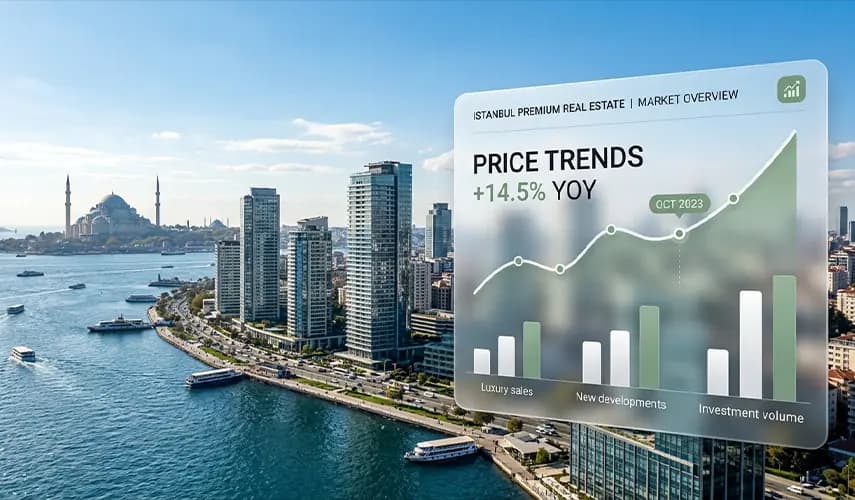
Market Summary (Quick Answer for Investors):
As of 2026, the average price of apartment in Istanbul ranges from 3.8 million to 11 million TRY (approximately $110,000 to $320,000 USD), depending strongly on the district, age of the building, and amenities. On average, buyers can expect to pay around 63,000 to 75,000 TRY (roughly $1,360 to $1,500 USD) per square meter. For the rental market, the city-wide average monthly rent sits between 25,000 and 27,000 TRY, though premium Bosphorus districts easily exceed 60,000 TRY.
1. Macroeconomic Overview of the Istanbul Property Market in 2026
Istanbul, the world's only metropolis bridging Europe and Asia, plays a unique role in connecting global capital flows and international real estate investments. In 2026, following a period of structural economic adjustments, the city’s real estate market has transitioned into a phase of mature, data-driven stability. For institutional investors and private buyers navigating the market through specialized platforms like istaproperty.com, an exact grasp of price drivers, infrastructural upgrades, and legal shifts is essential.
Macroeconomic data reveals that the average housing price across Turkey has reached approximately 5 million TRY (equivalent to $115,000–$120,000 USD based on mid-2026 exchange rates). However, Istanbul operates on an entirely distinct pricing paradigm. Evaluating the average price of apartment in istanbul requires recognizing that values are heavily dictated by geographical positioning, rapid transit connections, and structural seismic resilience. According to the Central Bank of the Republic of Türkiye (CBRT) and official valuation indices, the citywide average price per square meter for apartments ranges between $1,325 and $1,755 USD (approximately ₺63,000 to ₺70,000 per m²), while the overall median buyer market hovers closer to ₺55,000–₺58,000 per m².
Istanbul Price Indicators (Mid-2026)
├── Nominal Annual Growth (TRY): 26% – 28%
├── Real Market Return (Adjusted): -1.43% to -2.69% (Peripheral areas)
├── Average Price per Sqm: $1,325 – $1,755 USD
└── Local Mortgage Rates: 36% – 41.25%
From a capital growth perspective, the nominal house price index in Istanbul registered an annual increase of 26% to 28% in local currency. However, when adjusted for inflation, the real return (Real Return) in several peripheral districts turned slightly negative, dipping between -1.43% and -2.69%. This signaling confirms that speculative, short-term flipping has concluded. Furthermore, local mortgage rates remaining high at 36% to 41.25% have tamed domestic debt-driven demand, leaving the cash-rich foreign buyer market—fueled by strong hard currencies—exceptionally dominant.
Ready to Maximize Your ROI in Istanbul?
The 2026 market rewards informed investors. Contact the local experts at IstaProperty today for a free, data-driven consultation and discover projects with the highest capital appreciation potential before they hit the broader market.
Get a Free Consultation2. Infrastructure Expansion and Technical Demand Drivers
The evolution of the average cost of apartment in istanbul is no longer a simple product of inflation; it is structurally tied to aggressive urban transit expansions. The expansion of the rail network has rewritten the city's value map:
- The M11 Metro Line (Istanbul Airport to Halkalı): This corridor has directly integrated outer northern and western suburbs like Arnavutköy and Başakşehir into the city core. Properties along this transit artery are projecting capital appreciation of 20% to 30% over the course of 2026.
- The M12 Metro Line (Ümraniye–Ataşehir–Göztepe): On the Asian side, this line serves the newly fully-operational Istanbul International Financial Center (IFC), triggering a positive price premium of 15% to 25% for apartments situated within walking distance of its stations.
Beyond transportation, engineering standards deeply sway localized valuations. In the wake of regional seismic assessments, modern buyers willingly pay a 20% to 30% premium for new builds (0 to 5 years old) that feature certified compliance with the latest earthquake engineering codes. Additionally, secure residential compounds (Residences) offering smart-home automation, indoor pools, fitness centers, and 24/7 security add an average of 15% to 25% to the baseline value of a property compared to standalone older blocks.
3. Granular Analysis of the European Side Market
The European side of Istanbul houses nearly 65% of the city’s population and displays a vast spectrum of historic zones, modern central business districts (CBDs), and newly planned master communities.
Historic Districts and Cultural Transitions
- Fatih and Balat: Areas inscribed in the UNESCO World Heritage list are dominated by classical Ottoman wooden houses characterized by traditional Cumba (bay) windows. Investment here focuses heavily on cultural preservation and tourism. The average price per square meter in Fatih starts at $2,000 USD, with newer or thoroughly renovated apartments trading between $160,000 and $320,000 USD.
- Beyoğlu, Galata, and Cihangir: These neighborhoods highlight 19th-century Ottoman westernization, featuring Neoclassical and Art Nouveau architecture with high ceilings and heavy stone facades. Apartment prices range from $158,500 USD up to $800,000+ USD for restored historical flats. Driven by high short-term tourist demand, rental yields here remain highly lucrative.
Premium and Luxury Coastal Markets
- Beşiktaş: The absolute priciest district in Istanbul, famous for its historic waterfront mansions (Yalı) and ultra-luxury modern compounds. Extremely strict zoning laws along the Bosphorus line guarantee highly restricted supply. Square meter prices range from $3,500 USD to over $10,000 USD. A standard 150 m² premium flat averages $232,000 USD, though direct sea-view units effortlessly command multi-million dollar figures. Gross rental yields are lower here, ranging between 3.5% and 4.5%, due to the immense asset values.
- Şişلی and Nişantaşı: Şişلی serves as a commercial skyscraper hub, while Nişantaşı acts as a high-end fashion core (often called the Paris of Istanbul). Average prices sit firmly between $4,000 and $6,000 USD per m², requiring an investment budget from $150,000 to over $3 Million USD.
- Sarıyer: Highly favored by wealthy expatriates and diplomatic families, offering lush forest borders and Bosphorus views. One-bedroom layouts start near $990,000 USD, while family-sized 3-bedroom configurations reach $2.9 Million USD.
Mid-Range Markets and Family Enclaves
- Başakşehir: Widely recognized as "New Istanbul." Characterized by broad boulevards, massive botanical parks, and proximity to Europe's largest medical complex (Çam ve Şakura City Hospital). This district is a prime destination for conservative families and international investors. The average price per square meter stands at $2,975 USD, with standard layouts valued between $150,000 and $300,000 USD.
- Beylikdüzü: Featuring an organized grid urban layout and direct Metrobus access. A typical 2-bedroom apartment here ranges between $130,000 and $196,000 USD (approximately ₺3.9M to ₺5.4M).
- Bakırköy: An upscale, established coastal district along the Sea of Marmara. Premium shoreline projects like SeaPearl offer direct marine views with prices starting at $930,000 USD.
Emerging and Budget-Friendly Suburbs
- Esenyurt: The absolute volume leader in transactions. Housing over 50 newly built residential towers, it offers the lowest entry point into the European side. Prices per square meter vary between $1,200 and $2,175 USD. One-bedroom apartments can be acquired for $70,000 to $100,000 USD, pulling in high gross rental yields between 7.2% and 10.2%.
- Kağıthane: Rapidly transforming into a residential extension for the white-collar workforce of Levent and Maslak. Connected directly to the M11 airport line, 1 to 3-bedroom units range between $170,000 and $780,000 USD, generating steady rental yields around 8.4%.
- Zeytinburnu: Blending residential towers with commercial hubs, it commands one of the fastest capital payback periods in the city (approximately 18 years). Premium seaside units sell between $796,000 and $1.2 Million USD.
Explore Verified Listings in Prime Locations
Are you looking for secure, earthquake-resistant, and highly profitable real estate? Click here to Buy Property or Apartment in Istanbul through our exclusive portfolio and secure your investment today.
District (European Side) |
Market Category |
Average Price Range (USD) |
Gross Rental Yield |
Average Rent (TRY) |
|---|---|---|---|---|
Esenyurt |
Budget / High-Density |
$70,000 – $150,000 |
7.2% – 10.2% |
16,714 ₺ |
Arnavutköy |
Infrastructure Bound |
$80,000 – $160,000 |
6.5% – 7.5% |
16,948 ₺ |
Kağıthane |
Emerging CBD Extension |
$170,000 – $485,000 |
8.4% |
26,500 ₺ |
Beylikdüzü |
Mid-Range Family |
$130,000 – $270,000 |
5.0% – 6.0% |
21,000 ₺ |
Başakşehir |
Premium Master Plan |
$150,000 – $300,000 |
5.0% – 6.0% |
28,000 ₺ |
Beşiktaş |
Ultra-Luxury Coastal |
$232,000 – $3M+ |
3.5% – 4.5% |
59,283 ₺ |
Sarıyer |
Ultra-Luxury Premium |
$990,000 – $2.9M |
3.0% – 4.0% |
64,266 ₺ |
4. Granular Analysis of the Asian (Anatolian) Side Market
The Asian side accounts for roughly 35% of Istanbul's population, offering a calmer atmosphere, older family neighborhoods, and extensive green spaces.
Cultural and Historic Focal Points
- Kadıköy: The cultural heartbeat of the Asian side. Neighborhoods like Yeldeğirmeni represent the city's earliest planned apartment blocks, while Moda and the prestigious固定Bağdat Avenue cater to upper-class buyers. Average square meter prices hover between $1,800 and $3,500 USD. One-bedroom units start at $150,000 USD, while luxury flats in branded residences exceed $1 Million USD. Monthly rents average around 52,745 TRY.
- Üsküdar and Kuzguncuk: Famous for historical wooden architecture and a village-like coastal lifestyle. Modern residential projects in Üsküdar average $2,450 USD per m² (approx. ₺245,220), with entry-level homes starting at $150,000 USD.
New Financial and Commercial Hubs
- Ataşehir and Ümraniye: Driven by the full integration of the Istanbul International Financial Center (IFC), these two districts have become magnets for multinational corporations and high-earning financial sector employees. Standard 1 to 3-bedroom layouts in Ataşehir range between $160,000 and $310,000 USD, whereas Ümraniye’s newly built compounds vary between $130,000 and $600,000+ USD.
Eastern Coastal and Transit Gateways
- Maltepe: Offering direct panoramas of the Marmara Sea and the Princes' Islands, it targets young family buyers. Standard apartments sell between $150,000 and $259,000 USD, while premium beachfront developments ascend to $4,060 USD per m².
- Pendik and Kartal: Strategically linked to Sabiha Gökçen International Airport and the Marmaray rail link. Pendik represents one of the most reliable entry-level markets on the Asian side, offering quality layouts between $70,000 and $140,000 USD. Kartal presents more premium, high-rise coastal choices, with family residences starting between $580,000 and $700,000 USD.
5. Pricing Dynamics Based on Layout and Metrage
Evaluating the overall average house price in istanbul turkey requires adjusting for unit sizes. Layouts are designated by local terminology (e.g., 1+1, 2+1, 3+1):
40 m² Apartments (Micro & Studio Layouts)
Highly requested due to low monthly maintenance fees (Aidat), streamlined modern designs, and high rental liquidity for single professionals and students.
- In Sefaköy and Maltepe, a brand-new smart studio costs roughly $150,000 USD.
- In Kağıthane, this commands $170,000 USD.
- In central Şişلی, a micro-apartment reaches $200,000 USD—intentionally pricing units to cross legal residency thresholds.
70 m² Apartments (Compact 2+1 Layouts)
The absolute golden standard for young couples and small families.
- In premium districts like Beşiktaş, this layout commands ₺10M to ₺15M TRY ($300,000+ USD).
- In Şişلی, prices hover between ₺8M and ₺12M TRY.
- In suburban family communities like Beylikdüzü, the same layout falls between ₺2.5M and ₺5M TRY ($70,000 to $150,000 USD).
Macro Dimensions (The City Average)
Comprehensive 2026 data from Endeksa indicates that the citywide average gross area of listed apartments sits around 110 m². The average purchase price for a unit of this dimension is $154,664 USD, translating to an across-the-board average price of $1,406 USD per square meter.
Unit Layout |
Sample Localities |
Purchase Price Range (USD) |
Primary Investment Objective |
|---|---|---|---|
Studio / 1+1 (35–45 m²) |
Sefaköy / Maltepe / Esenyurt |
$48,000 – $150,000 |
Fast rental turnover, high liquidity |
Compact 1+1 (50–65 m²) |
Kağıthane / Göztepe / Bomonti |
$130,000 – $200,000 |
Expat rental, corporate leasing |
Economic 2+1 (70–95 m²) |
Beylikdüzü / Pendik / Avcılar |
$70,000 – $169,000 |
Middle-class local family market |
Standard 3+1 (110–140 m²) |
Başakşehir / Ümraniye / Kartal |
$154,664 – $400,000 |
Citizenship target, long-term stability |
6. Household Economics and Running Cost of Ownership
A frequent mistake foreign investors commit is focusing solely on purchase prices while ignoring ongoing maintenance fees, utility scaling, and living costs in Turkey.
According to metrics compiled via Numbeo and Wise for 2026:
- Single Individual: Estimated monthly living expenses (excluding rent) sit at $754 to $774 USD (approx. ₺33,257 to ₺36,058). When factoring in an economic apartment rental, the necessary monthly baseline budget scales to $1,050–$1,350 USD for an economic lifestyle, and $1,450–$2,100 USD for a comfortable routine.
- Family of Four: Monthly operational costs (excluding rent) average $2,821 to $2,872 USD (₺133,741). The total family budget, including a 3-bedroom apartment rental, school transportation, and standard necessities, moves between $2,300 and $2,900 USD for mid-tier living, scaling to $3,500 to over $8,000 USD if enrolling children in premier international institutions (where annual tuition can cost upwards of ₺1.16 Million TRY).
Ongoing Ownership Expenses (2026 Tariffs)
- Monthly Utilities: Basic services (electricity, water, gas heating, internet) average ₺2,500 to ₺5,500 TRY ($54–$119 USD) for a standard flat, peaking in winter due to natural gas heating.
- Monthly Aidat (HOA Fees): Managed compounds with extensive social facilities charge ₺2,500 to ₺12,000 TRY per month. Standalone older blocks charge nominal fees of ₺800 to ₺2,500 TRY.
- Annual Property Tax: Residential tax in Istanbul is calculated at 0.2% of the municipal assessed value (which is lower than actual market value), resulting in an annual bill between ₺3,000 and ₺10,000 TRY ($65–$217 USD) for normal apartments.
- Mandatory Insurance (DASK): Compulsory earthquake insurance combined with voluntary home protection ranges from ₺8,000 to ₺25,000 TRY annually.
- Local Income Indicator: The gross monthly minimum wage in Turkey for 2026 is ₺33,030 TRY (reflecting a 27% baseline adjustment).
7. 2026 Legal Framework: Real Estate Residency and Citizenship
Acquiring real estate in Turkey is no longer a mere economic transaction; it serves as a strict legal pathway to secure residency or a secondary passport. The immigration directorate enforces clear legal thresholds:
Short-Term Real Estate Residency (TAPU İkamet)
To qualify for a real estate-based property ownership residency permit, the property must meet a minimum value of $200,000 USD.
- Valuation Rigor: This value must be identical across both the official Title Deed (Tapu) and the official real estate appraisal report (Ekspertiz Raporu).
- Zoning Audits: The property must not be situated within "Closed Neighborhoods" (Mahalle Kısıtlaması)—zones restricted by the Ministry of Interior due to high foreign population density.
- The permit is issued for 1 to 2 years, renewable as long as title ownership is maintained.
Turkish Citizenship by Investment (TCBI)
The regulatory minimum for direct citizenship stands firmly at $400,000 USD.
- Transaction Protocol: Buyers can purchase single or multiple properties totaling $400,000 USD. Funds must be wired via a Turkish banking institution, converting foreign currency into local currency to obtain a Foreign Exchange Purchase Certificate (DAB).
- Three-Year Restriction: A legal restriction clause is placed upon the Title Deed, prohibiting the resale of the asset for 36 months. However, the owner retains absolute rights to generate foreign-currency linked rental income during this lock-in timeframe. Passport processing spans 3 to 6 months for the principal applicant, spouse, and children under 18.
Legal Program |
Minimum Investment Value |
Mandatory Operational Criteria |
Legal Status & Benefits |
|---|---|---|---|
Property Residency (İkamet) |
$200,000 USD |
Must match Tapu + Appraisal; avoid restricted zones |
1-2 Year renewable visa; local bank access |
Citizenship by Investment (TCBI) |
$400,000 USD |
Central Bank DAB certificate; 3-year resale lock |
Full passport for family; 3-6 month processing |
8. Return on Investment (ROI) and Capital Amortization
For analytical investors evaluating the average price of apartment in Istanbul, long-term yields reveal structural disparities between districts. The citywide average payback period (Amortization) for residential properties is calculated at 13 years, yielding an average gross rental return of 7.97%.
- High-Density Workers/Student Hubs (Esenyurt, Zeytinburnu): Offer the fastest amortization timelines, ranging between 11 and 18 years, driven by lower acquisition entries and relentless local rental demand.
- Developing Mid-Tier Hubs (Başakşehir, Kağıthane): Show payback periods between 19 and 24 years. While immediate rental yields are modest, their long-term capital appreciation remains exceptionally high due to pending infrastructure completions.
- Ultra-Luxury Zones (Beşiktaş, Elite Bosphorus Line): Show amortization cycles stretching beyond 35 years. Investors here ignore rental yields entirely, utilizing these world-class assets purely for global currency wealth preservation and inflation insulation.
Conclusion: Strategic Investment Roadmap
Navigating the average price of apartment in Istanbul in 2026 highlights a market that rewards micro-location awareness and structural safety. The era of blind speculative investing has been replaced by structured, long-term value acquisition.
Partnering with an established local advisory platform like istaproperty.com protects your investment against hidden structural risks, ensures absolute compliance with strict Tapu valuation rules, and aligns your asset selection with real immigration outcomes. Whether targeting a high-yield unit in Esenyurt or a premium family compound in Başakşehir, Istanbul remains an unmatched real estate engine across the Euro-Asian region.
Frequently Asked Questions (FAQ)
1. What is the real average cost of an apartment in Istanbul in 2026?
A typical citywide apartment costs between $110,000 and $320,000 USD (₺3.8M to ₺11M TRY). The citywide average for a standard 110 m² configuration stands at $154,664 USD.
2. What are the average rental prices across Istanbul districts?
The city wide monthly rental average hovers between 25,000 and 27,000 TRY. Peripheral zones like Esenyurt average 16,714 TRY, while high-end Bosphorus locations like Beşiktaş and Sarıyer routinely command between 59,000 and 64,000+ TRY.
3. What extra transaction costs should buyers budget for on top of the listing price?
Resale properties require a buffer of 6% to 8% for closing fees (Title deed tax, agency commission, mandatory DASK insurance, notary processing). New construction projects can demand 8% to 15% if value-added tax (VAT) applies.
4. Can I obtain a Turkish residency permit by purchasing a property below $200,000 USD?
No. Under current 2026 mandates, real estate-based tourist residency permits require a verified minimum valuation of $200,000 USD across both the deed registry and appraisal report. Any value lower will not qualify for an property-based İkamet.