



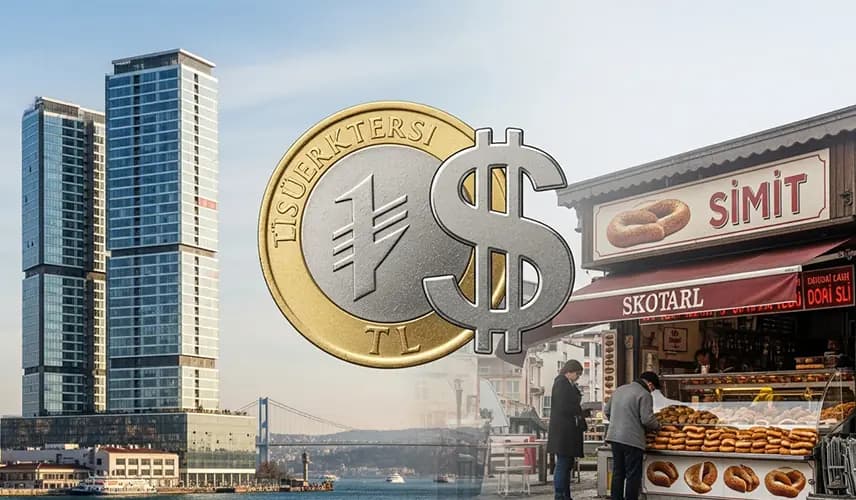
Istanbul, the enchanting metropolis that embraces two continents, has always been an attractive destination for immigrants, students, professionals, and tourists from all over the world. With its rich history, vibrant culture, delicious cuisine, and unparalleled Bosphorus views, this city offers a quality of life rarely found elsewhere. However, before any decision to migrate or take up long-term residence, the first and most important question that comes to mind is: "What is the real cost of living in istanbul turkey?"
This article serves as a complete, highly detailed, and accurate guide for 2026, relying on up-to-date macroeconomic data, official state statistics, and independent market research, to provide an item-by-item analysis of the istanbul living cost in this amazing city. We will not only look at dry numbers and figures but will also paint a realistic and tangible picture of what awaits you by presenting various lifestyle scenarios, comparisons with other cities, practical tips for budget management, and critical updates on real estate investment and residency laws.
Istanbul is a city of extreme economic contrasts; this is clearly reflected in its cost of living. While it is considered a relatively affordable city compared to European capitals like London or Paris and major American cities like New York, it is internally the most expensive city in Turkey. The economic operating environment in 2026 remains characterized by profound inflationary pressures and severe currency fluctuations. According to official data from the Turkish Statistical Institute (TurkStat), the nation's annual headline inflation rate accelerated to 31.53% in early 2026, though independent observatories like the Inflation Research Group (ENAG) estimate true consumer price inflation to be significantly higher. This bifurcated economic reality makes daily living expenses in istanbul a permanent challenge for those whose income is in Turkish Lira, while simultaneously offering massive purchasing power and arbitrage opportunities for expatriates earning in hard currencies (USD, EUR, GBP).
In this comprehensive guide, we will cover all financial aspects of life in Istanbul: from the biggest expense—housing and real estate investment—to the smallest—like a cup of Turkish coffee. Our goal is for you to plan your budget with clear sight and complete information, allowing you to fully enjoy life in this historic city.
Want to offset your living costs with high-yield investments? → Explore Istanbul Real Estate Projects with High ROI in 2026.
1. Quick Budgeting: Summary of Monthly Living Costs in Istanbul (2026)
Before diving into the details, it is helpful to have an overview of the estimated monthly costs for individuals and families with different lifestyles. These figures are averages and highly depend on your choices regarding the neighborhood, lifestyle, and spending habits when evaluating the cost of living istanbul offers. It is also important to note that to buffer against inflation, the state mandated a massive 27% increase in the gross monthly minimum wage for 2026, setting it at 33,030.00 TRY (approx. $1,000 USD). Highly skilled local professional and corporate white-collar salaries hover around $1,200 to $1,300 USD.
Macroeconomic Income-to-Cost Ratios & Spending Distribution:
- The Local Rental Crisis: In 2026, renting a standard one-bedroom apartment in the city center consumes up to 125% of a regular citizen's average local income, while moving to the outer suburbs still devours roughly 83% of that baseline salary.
- Overall Household Expenditure Distribution: According to data from independent institutions and financial platform breakdowns (such as Wise), an individual's budget in Istanbul typically displays the following structural footprint: 62% Housing/Rent, 15% Groceries, 9% Restaurants & Dining, 5% Utilities & Infrastructure Bills, 5% Leisure/Entertainment, and 4% Urban Mobility/Transportation.
Group |
Estimated Monthly Cost (USD) |
Details and Description |
|---|---|---|
Single Person (Economical Lifestyle) |
$1,050 - $1,350 |
This budget includes renting a small apartment outside the city center, using public transport, cooking at home, and limited leisure activities. |
Single Person (Average Lifestyle) |
$1,450 - $2,100+ |
This scenario includes renting a one-bedroom apartment in a decent neighborhood (perhaps not in the main center), a mix of eating at home and mid-range restaurants, gym membership, and more leisure. |
Four-Person Family (Average Lifestyle) |
$2,300 - $2,900 |
This cost covers the rent of a three-bedroom apartment outside the city center, basic groceries, transportation, and utilities for a family. |
Four-Person Family (Comfortable/Premium Lifestyle) |
$3,500 - $8,000+ |
This budget includes renting a three-bedroom apartment in a top-tier neighborhood, potential costs for private or international schooling (which have skyrocketed in 2026), car ownership, and premium family leisure activities. Remote workers with hard currency incomes exceeding $3,000 USD easily transition into the city's top 1% wealth tier. |
Important Note: Recent macroeconomic data from Numbeo suggests the cost of living in istanbul excluding rent is approximately $754 (approx. 33,257 TL) for a single person and $2,821 (approx. 124,340 TL) for a four-person family. This indicates that housing alone can account for 30% to 50% of your total budget.

2. Rent and Housing in Istanbul: Market Imbalances and District-Level Yields
Undoubtedly, monthly rent is the biggest and most determining cost of living in Istanbul. The housing market in 2026 is defined by severe, structural supply-demand imbalances, resulting in an acute affordability crisis for local residents and a highly competitive environment for incoming expatriates. Entering 2026, citywide residential rents jumped approximately 36% year-over-year, underpinned by an effective vacancy rate hovering between a mere 3% and 5%. Available rental listings are typically absorbed in under 30 days.
A general rule applies: the closer you get to the city center, tourist areas, and the Bosphorus shoreline, the prices in istanbul 2026 increase exponentially. However, robust 2026 data indicates a profound geographic paradigm shift: Kadıköy on the Asian side now frequently commands higher per-square-meter rents than historic European-side districts like Beşiktaş. The expatriate community continues to heavily cluster within the prestigious Bosphorus corridor (Bebek, Etiler, Ulus), where fully furnished units frequently fetch a 30% to 50% premium.
The table below presents the average rental prices for different apartment types based on 2026 market realities.
Type and Location |
Average Monthly Rent (USD) |
Average Monthly Rent (TL / GBP equiv.) |
Description |
|---|---|---|---|
One-Bedroom Apartment (City Center) |
$700 - $1,200 |
47,067 TL |
Areas like Şişli, Beşiktaş, Beyoğlu, and central parts of Kadıköy. |
One-Bedroom Apartment (Outside Center) |
$400 - $750 |
29,127 TL |
Areas like Beylikdüzü, Esenyurt, Kartal, or Pendik. |
Three-Bedroom Apartment (City Center) |
~$1,900 |
85,178 TL |
Suitable for families in popular central areas. |
Three-Bedroom Apartment (Outside Center) |
~$1,250 |
51,615 TL |
A more economical option for families in suburban areas. |
Key Tips on the Istanbul Housing Market:

- European vs. Asian Side: Traditionally, the Asian side (Anadolu Yakası) is considered calmer, though premium districts like Kadıköy have seen massive price surges.
- Incidental Costs (Aidat): In addition to rent, you must consider the "Aidat" fee. In larger complexes, this covers security, pool, and gym costs and can easily range from 2,000 TL to over 5,000 TL monthly.
- Initial Cost: When renting a home, you will typically need a budget equivalent to three to four times the monthly rent (including the deposit and the real estate agent's commission (Emlakçı)). Historically, historical user reports (e.g., Reddit 2024) cited prime central units near the Bosphorus running around €800, but 2026 market dynamics have shifted heavily upward.
- The Legal Rent Cap Friction: Turkish statutory law caps annual rent increases for sitting tenants based on the 12-month CPI average (which stood at 33.39% in early 2026). Because the actual free-market rate has surged much higher, a massive legal and financial chasm exists between old contracts and new listings.
3. Property Investment, Residency Thresholds, and Citizenship by Investment (CBI)
For foreign nationals, the acquisition of Turkish real estate is deeply intertwined with highly valuable immigration status. Entering 2026, the Turkish state has enforced stringent, sweeping revisions to pivot away from volume-driven investment toward higher-value, strictly audited capital injections.
- Citizenship by Investment (CBI) - The $400,000 Threshold: To qualify for citizenship via real estate, the absolute minimum value is $400,000 USD. The most disruptive regulatory shift in 2026 is the stringent enforcement of the GEDAŞ (Real Estate Valuation Center) system. The officially determined value on the Title Deed must exactly mirror the $400,000 minimum; artificial price manipulation has been aggressively eliminated. The property cannot be sold for 3 years.
- Property-Based Residency (Ikamet) - The $200,000 Threshold: The minimum property value required to secure a standard residence permit has been doubled to a rigid $200,000 USD. Furthermore, severe spatial restrictions mean that if the foreign population of any specific neighborhood officially exceeds 20%, that area is "closed" to new foreign residency registrations (e.g., large parts of Fatih and Esenyurt).
- Real Estate Purchasing Costs per Sqm: Buyers looking to acquire properties will find central urban real estate averaging approximately £2,335 per square meter, while decentralized outer suburban zones drop to around £1,232 per square meter. Across Turkey, the nationwide real estate baseline average scales around $900 per square meter.
- Friction and Tax Traps: Investors must meticulously model transaction costs. The Title Deed Transfer Tax (Tapu Harcı) is legally set at 4% of the declared value. Value Added Tax (KDV) for commercial or new residential assets is 20%. Crucially, standard Turkish Tax Law dictates that selling any real estate within 5 years of acquisition automatically triggers a heavy Capital Gains Tax ranging from 15% to 40%.
Gross Rental Yields by District (For Investors)
Istanbul presents a paradox: despite having the highest rent prices, gross rental yields in premium areas are suppressed due to explosive capital appreciation. Strategic investors look to the periphery.
Istanbul District |
1-Bed Cost ($) |
1-Bed Rent ($) |
Gross Rental Yield (%) |
|---|---|---|---|
Beylikdüzü |
$45,800 |
$570 |
14.93% (High Yield Option) |
Küçükçekmece |
$78,000 |
$690 |
10.62% |
Şişli |
$112,400 |
$670 |
7.15% (Central Hub) |
Kadıköy |
$248,300 |
$1,100 |
5.32% (High Capital Appreciation) |
Why deal with unpredictable rent hikes? Secure a Turkish Residence Permit or Citizenship by investing in premium real estate. → View Residency-Eligible Properties in Istanbul.
4. Food and Groceries Costs: Navigating 36% Food Inflation
Fortunately, food and groceries in Istanbul can still be very affordable for those earning in foreign currency, though food and non-alcoholic beverages have experienced a devastating 36.44% year-on-year inflationary surge for local residents in 2026. When considering istanbul food prices 2026, the city remains a paradise for food lovers, offering a variety of options from cheap street food to Michelin-starred restaurants.
A) Monthly Grocery Cost (The Key to Saving)

The monthly grocery cost for a single person who prepares most of their meals at home ranges between $150 and $300 (approx. £184). For an expat couple, a well-allocated monthly supply scales around €380. The key to reducing costs is shopping at weekly local markets (Pazar), where you can buy fresh fruits, vegetables, cheese, olives, and eggs at a much lower price than chain supermarkets, and avoiding heavily taxed imported luxury goods.
Grocery Item |
Average Cost (TL) |
Average Cost (USD Range / References) |
|---|---|---|
Milk (1 Liter) |
51.64 TL |
$0.85 - $1.23 |
Fresh White Bread (1 lb / 500g loaf) |
32.92 TL |
$0.40 - $0.65 (A small 200g loaf runs ~$0.35) |
Dozen Eggs |
107.83 TL |
$1.50 - $2.30 |
Chicken Fillets (1 kg) |
268.20 TL |
$3.00 - $6.33 |
Local Cheese (1 kg) |
211.50 TL |
$4.00 - $9.60 |
White Rice (1 kg) |
57.30 TL |
~$1.30 |
Fresh Produce (1 kg) |
Varies |
Apples: $1.00, Bananas: $1.10, Tomatoes: $0.90, Potatoes: $0.60. (Fresh seasonal greens stay under $1.50/kg) |
B) Dining Out Costs in Restaurants and Cafes
The restaurant and hospitality sector has aggressively passed crushing wholesale food and labor inflations directly to the end consumer. However, dining out remains accessible on various budgets if managed correctly and is a significant part of the overall prices in istanbul.
Meal Type |
Average Price (TL) |
Average Price (USD / Reference) |
|---|---|---|
Meal in Inexpensive Restaurant (Lokanta) |
500.00 TL |
$5.00 - $11.00 (approx. £8) |
Meal for Two (Three Courses, Mid-Range) |
2,200.00 TL |
$25.00 - $55.00 (approx. £39) |
McMeal at McDonald's (or equivalent Combo) |
322.00 TL |
~$7.30 |
Regular Cappuccino |
124.00 TL |
$2.81 (approx. £3) |
Domestic Beer (0.5 Liter Draft) |
129.00 TL |
~$2.92 |
Imported Beer (0.33 Liter Bottle) |
180.00 TL |
~$4.09 |
Special Attention to Alcohol & Entertainment: The Turkish government imposes heavy Special Consumption Taxes (ÖKT) on alcohol. Prices of alcoholic drinks in bars are steep compared to food, making frequent nights out highly impact-heavy on your finances (historical logs show rapid jumps over recent years from 30-45 TL up to these modern 2026 scales). For lifestyle activities, fitness club memberships span $20 to $85 monthly , cinema entries run $3 to $8, and theater/concert tickets extend from $8 to $59 depending on scale.
5. Public Transportation and Utilities: The 2026 Restructuring
Istanbul has an extensive, integrated, and efficient public transport system, including the Metro, Tram, Bus, Metrobus, Marmaray (undersea train), and passenger ferries (Vapur). Following intense political debate in 2026, fares were universally hiked by 30% to 35% to offset global fuel inflation and state-mandated municipal wage increases.
A) Transportation Costs (Istanbulkart is Essential)
To use all public transport options, you need an "Istanbulkart". The absolute cost of urban mobility has skyrocketed, but remains vital.
Item/Service |
New 2026 Fare (TL) |
Average Cost (USD / References) |
Description |
|---|---|---|---|
Monthly "Blue Card" (Full Adult Network) |
1,980.00 TL - 3,298.00 TL |
$18.00 - $45.00 |
Allows unlimited use of transport lines; a financial necessity for daily commuters. Students enjoy massive institutional discounts. |
Standard Electronic Ticket (Single Swipe) |
31.00 TL - 42.00 TL |
$0.90 / £0.69 |
Cost per single ride on Metro, Bus, or Tram lines. |
Taxi Start Fee / Minimum Fare |
35.00 TL / 210.00 TL |
Base: $0.60 - $0.85 |
The minimum short-distance taxi trip fare was aggressively increased to 210 TL to match 2026 inflation. |
Private Vehicle Ownership / Fuel |
Approx. 47 TL per Liter |
Fuel & Maintenance: |
CRITICAL FACTOR: Buying a car in Turkey triggers an immense Special Consumption Tax (ÖTV), hitting up to 220% of vehicle value! A brand-new BMW 5-Series starts around €130,000. |

B) Monthly Utilities (Services): Electricity, Gas, and Internet
Operating a household in Istanbul requires navigating a utility sector sensitive to global shocks. The government heavily subsidizes residential natural gas to insulate consumers from global energy spikes.
Item/Service |
Average Cost (TL) |
Average Cost (USD / References) |
Description |
|---|---|---|---|
Basic Utilities (Electricity, Heating, Water, Garbage) |
2,200.00 TL - 3,152.83 TL |
$50.00 - $180.00 |
Based on an 85 sqm residential apartment. Poor insulation can push winter gas heating bills past 5,000 TL. |
Internet (Unlimited High-Speed) |
440.00 TL - 683.78 TL |
$10.00 - $15.00 (approx. £12) |
Turk Telekom and Turkcell offer robust fiber optic connectivity at a fraction of Western costs. |
Mobile (Unlimited Calls + 10GB Data) |
220.00 TL - 495.94 TL |
$5.00 - $10.00 monthly |
Fierce domestic competition keeps local mobile data plans highly affordable. |
6. Incidental Costs: Health, Education, and Bureaucracy
Life is not just about eating and sleeping. Health, education, and administrative costs form a critical part of the expat budget in 2026.
Healthcare Infrastructure and Medical Tourism
Turkey possesses a highly complex dual-track healthcare system. Expats generally prefer the 35 elite JCI-accredited private hospitals.
- State Insurance (SGK): For non-working foreigners opting into the public system, the monthly premium is legally fixed at 24% of the gross minimum wage. Following the wage adjustments up to 2026, this equates to 7,927.20 TL (~$180 USD) monthly. (Note: Foreign nationals generally qualify for public insurance tracking after 1 continuous year of legal residency).
- International Private Medical Insurance (IPMI) & Out-of-Pocket costs: Standard local expat medical policies run between $60 to $100 monthly for basic care, and up to $200 monthly for comprehensive coverage. Elite global policies (like Cigna or Bupa) that guarantee direct billing at premium private hospitals average $5,511 USD annually. For standard non-insured out-of-pocket consultations, general practitioners cost $30 to $80, specialists cost $50 to $100, and private emergency room visits map between $100 and $300.
Out-of-pocket medical costs in Turkey represent massive arbitrage opportunities, fueling a booming medical tourism industry:
Medical Procedure |
Cost in Turkey (USD) |
Cost in USA (USD) |
|---|---|---|
Dental Implants |
~$444 per implant |
$1,500 - $3,000 |
Hair Transplant |
~$1,400 |
$4,000 - $11,000 |
The Education Sector: Hyperinflation and International Schooling
For expatriate families, education is unequivocally the most volatile component of living in Istanbul. The education sector experienced a catastrophic 55.7% year-on-year inflationary spike in 2026. Elite international schools (like MEF or BIS) operate exclusively in hard currency. High School tuition at these top-tier institutions has breached an astonishing $45,000 USD per academic year, while mid-tier international or bilingual entities fall between $4,000 and $12,000 annually. Standard private local K-12 schooling maps between $1,120 and $2,500 monthly.
Administrative Bureaucracy: Visas and Residence Permits
Navigating the labyrinthine immigration bureaucracy involves a rigid matrix of mandatory fees for 2026:
- Residence Permit Card Fee: 964.00 TL (mandatory for all).
- Annual Residence Tax: Strictly pegged to ~$80 USD for citizens of the USA, UK, Canada, and EU.
- Single Entry Visa Fee Penalty: If you enter Turkey without a formal consular visa and apply for residency, you face a massive penalty of 9,376.40 TL.
7. Comparative Analysis: Istanbul vs. the World and Ankara
To better understand the cost of living in istanbul, it is essential to compare its costs with those of other major cities around the world and within Turkey.

Istanbul vs. Major Western Cities
Despite the severe domestic hyperinflation, Istanbul remains an immensely attractive, highly strategic arbitrage for expats earning in hard currencies. A single person can cover basic living expenses in Istanbul with much less than in a major American city.
Cost (Average) |
Istanbul (USD) |
New York (USD) |
London (USD) |
Ankara (USD) |
|---|---|---|---|---|
One-Bedroom Apartment Rent (City Center) |
$700 - $1,200 |
$4,100+ |
$2,600+ |
~$163 |
Total Monthly Costs (Single, Excl. Rent) |
~$750 |
$1,500+ |
$1,200+ |
~$682 |
The Main Challenge: The White-Collar Premium
One of the main challenges of living in Istanbul is the gap between official minimums and actual living costs. While the statutory minimum wage sits around $1,000 USD (33,030 TL), the average localized monthly salary in Istanbul for highly skilled professionals (banking, software, multinationals) commands a massive geographic premium, hovering between $1,200 and $1,300 USD. This deep gap imposes significant economic pressure on Turkish citizens working outside corporate hubs.
8. Lifestyle Scenarios: How Much Money Do You Need for What Kind of Life?
To bring the figures closer to the reality of daily life, here are three monthly budgeting scenarios for three different lifestyles in 2026.
Scenario 1: International Student (Economical Budget)
- Accommodation: A room in a shared apartment or student dorm ($100 - $200/month) located in a student neighborhood away from the center (Avcılar or Asian side).
- Groceries & Fees: Mostly cooking at home, shopping at local markets, and paying university tuition ($500 - $4,000/year).
- Estimated Monthly Total: Around $350 to $900 in total. Highly subsidized student transport card discounts and affordable state insurance configurations make this completely feasible.
Scenario 2: Digital Nomad / Single Foreign Professional (Average Budget)
- Accommodation: Modern one-bedroom apartment outside the main center but with good transport access (Göztepe or parts of Şişli).
- Dining Out: Several times a week at mid-range restaurants. State-of-the-art fitness club membership (approx. 2,980 TL monthly).
- Estimated Monthly Total: Around $1,450 to $2,100+.
Scenario 3: Expat Family of Four (Comfortable Corporate Budget)
- Accommodation: Three-bedroom apartment in a compound (Site) with premium facilities in a highly desirable neighborhood (Zekeriyaköy or parts of Kadıköy).
- Education & Perks: Elite international school tuition for two children, premium insurance matrices, and private vehicle operational costs.
- Estimated Monthly Total: $6,500 to $9,000+ (Heavily weighted by the massive spike in international school fees that cross $45,000/year per child, alongside premium private health policies).
9. The Challenge of Inflation and Currency Fluctuations: A Crucial Point for Expats
Perhaps the most important factor to consider when financially planning life in Istanbul is the high inflation and severe volatility of the Turkish Lira.
- Advantage for Foreign Currency Earners: For migrants earning in dollars, pounds, or euros, the weakening Lira can be an advantage. Your foreign currency purchasing power increases. For example, a cinema ticket averages 430 TL (roughly $10 USD), allowing foreign-earning professionals to maintain an elite quality of life.
- Challenge for Lira Earners: This situation is a major challenge for those earning in Lira, as price increases are rapid and continuous.
Key Advice for Corporate Relocations: Traditional algorithmically generated cost-of-living adjustments fail completely to capture the asymmetric inflation defining Istanbul in 2026. Expatriate compensation packages must heavily, almost disproportionately, index the cost of international schooling and elite medical insurance.
10. 11 Golden Tips for Reducing Living Costs in Istanbul
Living affordably and smartly in Istanbul is entirely possible. Here are a few tested strategies for managing your budget and protecting your capital:
- Live Outside the City Center: Save up to 50% on rent by choosing a suburban neighborhood with good Metro or Metrobus access.
- Embrace Public Transport: Use the monthly transport card (Mavi Kart). Car ownership is a luxury expense, not a necessity.
- Shop at Local Markets (Pazar): Get fresh fruits, vegetables, and dairy at a fraction of the supermarket price from these weekly markets. Integrating into local agricultural supply chains is a strict financial necessity.
- Cook at Home: Take advantage of fresh, affordable domestic ingredients and drastically reduce your food costs.
- Enjoy Lokantas and Street Food: When dining out, go to the local eateries (Lokanta) instead of tourist restaurants ($5 - $11 per meal vs high premium alternatives).
- Discover Free Entertainment: Walking along the Bosphorus, exploring beautiful parks like Yıldız Park or Emirgan, and visiting historic neighborhoods like Balat cost nothing.
- Learn Basic Turkish: Learning basic Turkish phrases will make your daily life and interactions much easier and protect you from inflated pricing.
- Verify the GEDAŞ Audit (For Investors): Never wire funds for property investment without securing and verifying the official government valuation to ensure CBI compliance.
- Beware the 5-Year Tax Trap: If you buy property, plan to hold it for at least 5 years to avoid punishing Capital Gains Taxes upon sale.
- Leverage Brand Substitution for Imports: Standard VAT (KDV) sits at 20%, but imported items (electronics, designer clothing, niche foods) often retail at double their global pricing due to severe import levies. Buying Turkish domestic brands mitigates this premium.
- Budget for Hidden Housing Fees: Always factor the monthly apartment complex 'Aidat' fee into your initial cash flow forecasts before choosing a luxury residential compound.
Planning Your Relocation to Istanbul?
Navigating the real estate market, residency laws, and financial planning in Turkey can be complex. Let our local experts handle it for you.
Book a Free Investment & Relocation Consultation11. Frequently Asked Questions (FAQ) About the Cost of Living in Istanbul
1. How much monthly income do I need for a comfortable life in Istanbul?
In 2026, for a single person, a hard-currency income of about $1,600 to $2,000 per month provides a comfortable life with savings and leisure possibilities. For a four-person family (excluding international school tuition), an income between $3,500 and $4,500 can secure a premium standard of living.
2. Is Istanbul an expensive city for students?
Compared to other major European cities, no. The cost of living for international students is relatively low. By living in a shared apartment or dorm and utilizing heavily subsidized student transport and health discounts, one can comfortably live on a budget between $350 and $900 per month.
3. What are the best and most affordable neighborhoods for living?
- For an average budget: Göztepe, Bostancı, Ataşehir (Asian Side) and Bahçelievler, Bakırköy (European Side) are good options.
- For an economical/investor budget: Beylikdüzü, Esenyurt, Avcılar (West) offer significantly lower rents and higher gross rental yields (up to 14%).
4. What is the status of the healthcare system for foreigners?
Foreigners can be covered by the Turkish state insurance (SGK) by paying a monthly premium of approx. 7,927.20 TL (~$180 USD) matching 24% of the 2026 gross minimum wage, or they can use private International Medical Insurance (IPMI). Turkey has very modern and high-quality private hospitals whose out-of-pocket costs are a fraction of what they are in Europe and the US.
Final Conclusion: Istanbul, a City for Every Budget and Strategic Investor
Istanbul is a city that welcomes everyone with open arms, though its 2026 economic landscape is highly complex. It can be surprisingly affordable or outrageously expensive; everything depends on your choices. The deliberate strategic pivot by the state toward high-value, heavily vetted immigration (evidenced by the $200k residency and $400k CBI thresholds) indicates a rapid maturation of the market. Istanbul is no longer a frontier destination for low-barrier entry, but rather a sophisticated economic theater that disproportionately rewards well-capitalized, legally compliant, and strategically patient expatriates and investors.
However, what makes Istanbul unique goes beyond the macroeconomic numbers. The city's energy, the hospitality of its people, the taste of hot simit by the Bosphorus, and the sound of the call to prayer echoing through historic alleys are values that cannot be captured on any financial balance sheet. With careful planning, deep market research, and some flexibility, living and investing in this legendary metropolis can become one of the most rewarding experiences of your life.