



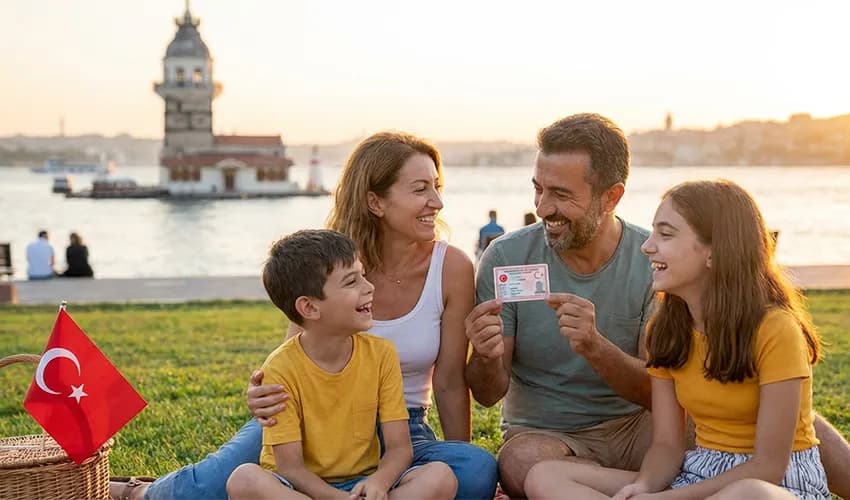
Radical changes in the Republic of Turkey's immigration policies between 2024 and 2026 have painted a new landscape for foreigners, especially families and individuals under 18. These developments, aimed at enhancing security oversight, managing foreigner population density, and standardizing administrative procedures, have added new complexities to obtaining a Residence Permit (Ikamet). To navigate this accurately, one must first note that under the legal age in Turkey, all individuals under 18 are defined as "minors," and their residency status is directly tied to the legal standing of their parents or guardians. This analysis provides a detailed look at residence permit types, documentation requirements, geographical challenges, and educational rights for children in Turkey.
The New Turkish Residency Law 2026 for Minors
All activities regarding foreigner residency in Turkey are rooted in "Law No. 6458 on Foreigners and International Protection." This law has undergone serious reforms recently, particularly in response to unprecedented immigration demand. While Turkey was known for easily issuing short-term residencies in the past, the new Turkish residency law 2026 adopts a highly selective and purpose-based approach. For individuals under 18, simply being on Turkish soil or renting an apartment no longer guarantees an Ikamet card. The Directorate of Migration Management (Göç İdaresi) now scrutinizes the ties between the child, the parents, and the purpose of stay with intense precision.
Area of Change |
Previous Status (Pre-2023) |
New Status (2026) |
|---|---|---|
Real Estate Investment Limit |
$75,000 (Major Cities) |
$200,000 (All Cities) |
Biometric Authentication |
Limited to photos |
Mandatory fingerprinting (all ages) |
Neighborhood Density Cap |
25% of local population |
20% of local population |
Financial Transparency |
Simple income declaration |
Bank statements & payroll required |
Renting an apartment no longer guarantees residency for your children. Secure a guaranteed Family Residence Permit by investing in a property in Istanbul. → View Residency-Approved Properties.
Pathways to Turkish Residency for Minors

Choosing the correct residency type is the first and most vital step. For minors, Turkish law outlines specific pathways based on family status or education.
Family Residence Permit (Aile İkamet İzni)
The Family Residence Permit is the strongest type of residency for children. It is granted to the spouse and children under 18 of a person who holds a valid residency (work, real estate, or student) or Turkish citizenship. The primary applicant is known as the "Sponsor" (Destekleyici) and assumes financial and legal responsibility. A major advantage of this residency is the right to free education in Turkish public schools without needing a separate student visa.
Student Residence Permit (Öğrenci İkamet İzni)
If the child's parents do not reside in Turkey, or if the child independently applies to study at international schools or universities, a student residency is issued. There are strict requirements for appointing a legal representative or guardian inside Turkey. The Turkish educational institution must confirm official enrollment, and the Migration Authority must verify safe housing and supervision.
Short-Term Touristic and Real Estate Residency
If a family purchases real estate worth at least $200,000 in Turkey, children under 18 can obtain short-term residency as dependents. However, regarding simple touristic residencies (based on rental contracts), the general policy in 2026 is to refuse new issuances or renewals in most districts unless highly justified.
Required Documents for Minor Residency (2026 Update)
The application process for minors requires documents that unequivocally prove the legal relationship between the child and parents. Any ambiguity will result in an immediate rejection.
Official Letter of Consent (Muvafakatname)
This document is the "Achilles' heel" of residency files for individuals under 18. The Turkish government is extremely sensitive to family protection laws to prevent illegal child relocation. If the child is in Turkey with only one parent, an official, notarized letter of consent from the absent parent in the home country is strictly mandatory.
Parental Presence Scenario |
Mandatory Document (Beside ID) |
|---|---|
Both parents present in Turkey |
Translated Birth Certificate & Marriage Certificate |
Only one parent present |
Notarized Consent (Muvafakatname) from absent parent |
Divorced parents |
Final Custody Decree (Translated & Apostilled) |
Deceased parent |
Official Death Certificate (Consularly Attested) |
For foreigners, this consent must either be drafted at a notary in the home country and attested by the Ministry of Foreign Affairs and the Turkish Embassy, or drafted at the home country's consulate in Turkey and attested by the local Governor's office (Kaymakamlık). Legally, the letter must explicitly state "permission to obtain residency in Turkey" and "permission to study." Many parents ask about the travel age for Turkey; while minors can travel, establishing legal residency requires this precise paperwork.
Struggling with Legal Translations & Consent Forms?
A single missing apostille can ruin your child's residency application. Buy your home with Istaproperty, and our legal department will handle all family documentation flawlessly.
Consult a Legal Expert TodayRestricted Neighborhoods in Turkey: 2026 Closed Areas List
One of the biggest hurdles to obtaining residency is the ever-expanding list of "Closed Neighborhoods." This law is based on the logic that excessive concentration of foreigners in one place challenges social cohesion and local demographics.
Currently, over 1,169 neighborhoods across Turkey are closed to new residency issuances. Families must verify the status of their desired neighborhood on the official Migration Authority website before renting or buying, as residing in a closed area guarantees an automatic rejection, even with perfect documents.
Government Fees and New Health Insurance Rules
Entering 2026, new health insurance requirements for foreigners have been introduced, increasing the cost of living for families. These changes aim to ensure adequate coverage for expensive medical treatments. When budgeting, parents also often search for Turkish passport fees for children 2026 if they are applying for citizenship, which involves separate government duties.
For minors under 18, if they are covered under a Family Residency and the parents' SGK insurance (especially parents with work permits), separate private insurance may not be needed. However, for short-term residencies, private health insurance is mandatory for all family members.
Education and the Equivalency (Denklik) Process
A major motivation for families immigrating with minors is utilizing the Turkish education system. Education is compulsory for all children, regardless of immigration status.
The Denklik Process
For a foreign student to enroll in a Turkish school, they must prove their previous education aligns with the Turkish system through a process called "Denklik":
- Online Phase: Register on edenklik.meb.gov.tr and upload scanned, attested educational documents.
- In-Person Phase: Visit the Directorate of National Education (Milli Eğitim) with original documents and official translations.
Biometric Appointments for Minors

The Migration Authority now enforces biometric authentication for all residency applicants, including minors (at the officer's discretion based on age). The child must be physically present at the appointment (rendezvous) booked via e-ikamet with at least one parent (with consent from the other). Upon approval, the Ikamet card is mailed via PTT within 30 to 90 days.
Secure Your Child's Education and Future
Navigating Turkish schools, restricted zones, and immigration laws is overwhelming. Partner with Istaproperty to find the perfect home in a safe, residency-approved neighborhood.
Get a Free Relocation ConsultationFinal Recommendations for Families
The developments of 2026 show that Turkey is no longer a destination for "simple, cheap residencies." It has transitioned into an environment where only individuals with clear goals (education, work, or investment) and flawless legal documentation can build a stable future for their children. Always check if a neighborhood is open before moving, and remember that investing in real estate over $200,000 remains the safest, most guaranteed pathway to family residency.