


 English
 فارسی
فارسی
 العربية
 русский
 USD
USD
 TRY
TRY
 EUR
EUR
 IRR
IRR
 RUB
RUB

Imagine waking up, checking the global market indices, and realizing that your local currency or traditional assets are losing value at an alarming rate. You decide to hedge your capital by purchasing a luxury apartment in Istanbul, aiming to both preserve your wealth and secure a second passport. Everything proceeds smoothly until the day of the title deed signing, when a Turkish government appraiser informs you that the property you purchased for $400,000 is officially valued by their system at only $250,000. In an instant, your dream of citizenship vanishes.
This scenario has been a terrifying reality for many international investors in recent years. However, in 2026, the landscape has fundamentally shifted. Regulations are stricter, digital monitoring systems are more integrated, and it is no longer possible to proceed using "informal" or traditional methods.
As an investment migration specialist tracking global capital flows, I am here to reveal not just the laws written on paper, but the on-the-ground realities, hidden costs, and the specific legal traps of 2026. This is not a sales brochure; it is the strategic roadmap to safeguard your capital.
Part 1: Basic Laws and Key Changes in 2026
Investment Thresholds: What the Official Numbers Say
To obtain Turkish citizenship in 2026, several primary routes remain available, but the executive details are vital for foreign investors to understand before committing funds.
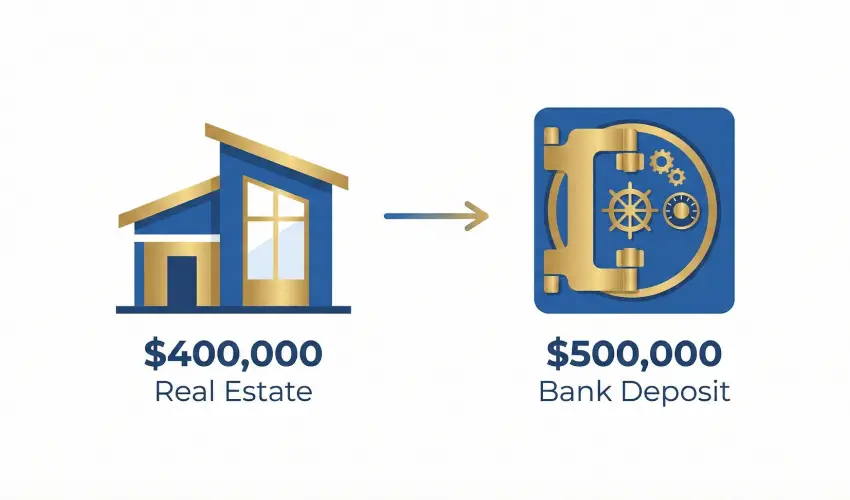
- Real Estate Acquisition (The Most Popular Route): You must purchase property with a minimum value of $400,000 USD.
- Crucial Note: This exact amount must be explicitly declared on the Title Deed (Tapu).
- Commitment: You must legally pledge not to sell the property for a minimum of 3 years.
- Bank Deposit or Bond Purchase: Depositing a minimum of $500,000 USD in a Turkish bank for a period of 3 years.
Master the Regulations
The legal landscape is strict. To ensure your capital is protected and your application succeeds, you must understand the latest rules governing turkish citizenship by investment. Dive into our exclusive pillar report detailing exactly how to execute a flawless turkey citizenship by investment strategy in 2026.
The 2026 Paradigm Shift: The "Rayiç Bedel" (Official Valuation) Reality
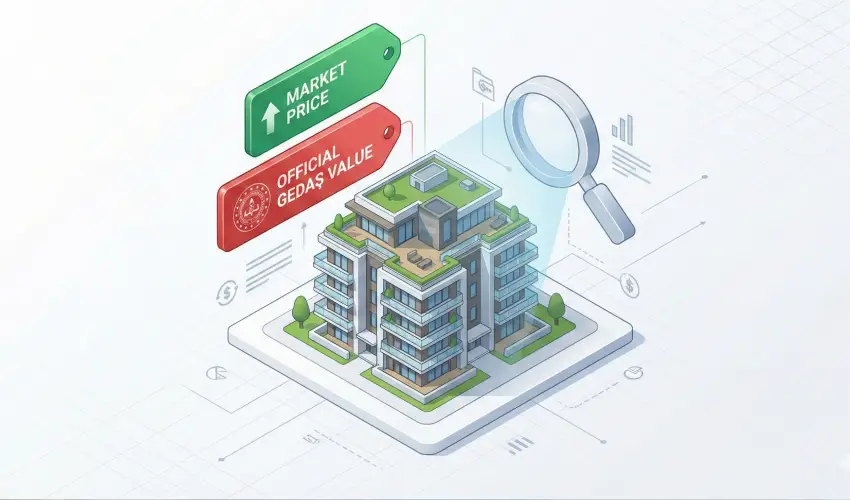
In the past, developers often undervalued properties on official documents to reduce tax liability, taking the balance through informal channels. As of January 2026, the Turkish government has effectively closed this loophole through the GEDAŞ (Real Estate Valuation Center) system.
The Law: All real estate transactions must match the "Official Determined Value" (Rayiç Bedel). If you purchase a property for $400,000, but the government-appointed expert values it at even $399,000, your citizenship application will be rejected. Price manipulation through back-door agreements with sellers is now a high-risk move that leads to immediate disqualification. For investors coming from high-inflation markets or those accustomed to cash transactions, this is the most dangerous hurdle.
Part 2: Global Banking & Security Challenges (The Hidden Risks)
International investors face challenges that many standard agencies overlook. Let’s speak candidly about the operational risks in 2026.
1. The Money Transfer Puzzle and the DAB
To qualify, you must obtain a Foreign Exchange Purchase Certificate (DAB - Döviz Alım Belgesi). This means your USD or EUR must enter the Turkish banking system and be converted into Lira by the Central Bank.
- The "Source of Funds" Scrutiny: In 2026, Turkish banks have reached peak sensitivity regarding Anti-Money Laundering (AML) regulations. If your capital arrives via unverified intermediaries or third-party exchange houses without a clear audit trail, the DAB certificate will not be issued, and your funds may be frozen.
- The Warning: Never carry large amounts of cash physically and never deposit cash directly into a developer's account. Only documented bank-to-bank transfers with the explicit memo "For property purchase for citizenship" are recognized by the immigration authorities.
2. Multi-layered Security Screening (Security Clearance)
The security vetting process for foreign nationals has intensified in 2026. Statistics: Rejection rates for applicants from "high-risk" or complex geopolitical jurisdictions currently range between 10% and 15%.
Background checks now involve deep-dive inquiries from international databases and business activity audits. If your name or business interests intersect with global sanction lists or political exposure, the process can extend beyond 12 months or result in a flat rejection without refund of investment costs.
Part 3: Hidden Costs; What is the Real Budget?
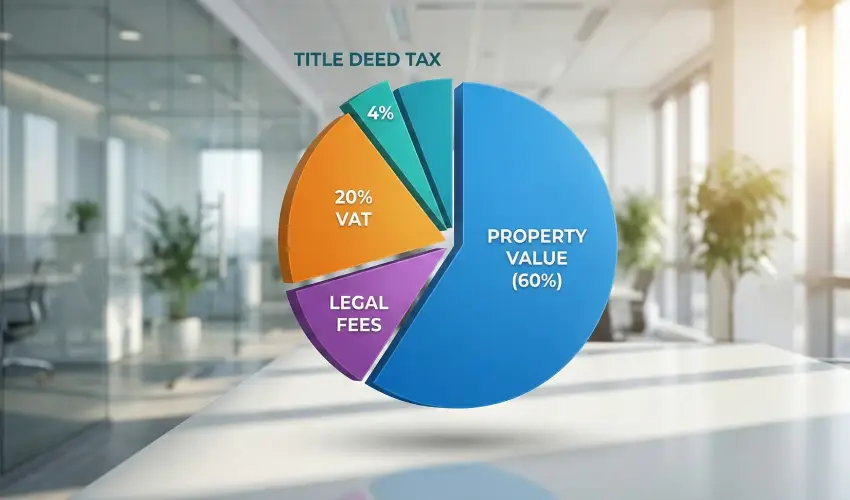
Many websites market "Citizenship for $400,000." While the investment floor is $400k, it is not the total expenditure. You must budget an additional 7% to 12% for secondary costs.
- 1. Title Deed Transfer Tax (Tapu Harcı): 4% of the property value ($16,000 for a $400k purchase). While traditionally split, market custom in Turkey usually places this entire cost on the buyer.
- 2. Value Added Tax (KDV): In 2026, the standard rate is 20%. While "first-time foreign buyers" can apply for an exemption, the bureaucratic requirements are so complex that many investors end up paying the full amount to avoid delays.
- 3. Legal and Notary Fees: Expect to pay $5,000 to $10,000 for reputable, independent legal representation.
- 4. Translation and File Management: Approximately $1,000 to $2,000 for a standard family application.
The Reality: For a $400,000 investment, you must have $430,000 to $450,000 in total liquidity. If your budget is exactly at the minimum threshold, do not start the process.
Part 4: The "3 Years vs. 5 Years" Tax Trap
This is the most critical financial advice that sales-driven agencies will hide from you.
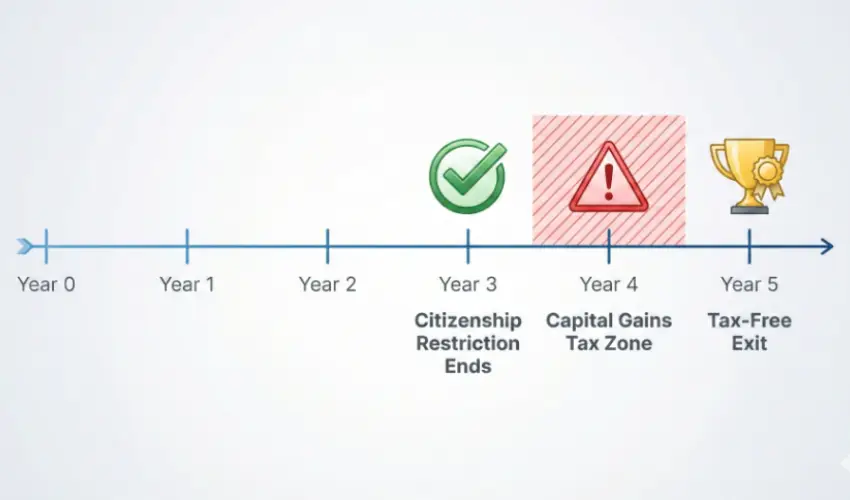
CBI Law: "You must not sell the property for 3 years."
Turkish Tax Law: "If you sell any property within 5 years of acquisition, you must pay Capital Gains Tax."
The Scenario: You buy in 2026. In 2029, the 3-year restriction is lifted, and you decide to sell to liquidate your capital. Because you have held the property for less than 5 years, the Turkish government will calculate the profit based on inflation-adjusted figures and tax you heavily (between 15% and 40%). To exit the market tax-free, you must maintain a 5-year investment horizon.
Part 5: The "Tech Visa": A New Window for Specialists
If you are a specialist, developer, or startup founder without $400,000 in immediate liquidity, the 2026 Tech Visa program is a strategic alternative.
- Benefits: A 3-year expedited work permit, family residency, tax exemptions, and access to Turkey's specialized Technology Parks.
- Objective: Designed for those seeking to relocate their professional life and avoid restrictive local regulatory environments.
- Path: This is a lower-cost entry point that allows you to live and earn in Turkey, leading to a citizenship application through the 5-year work residency route.
Part 6: Executive Checklist for 2026
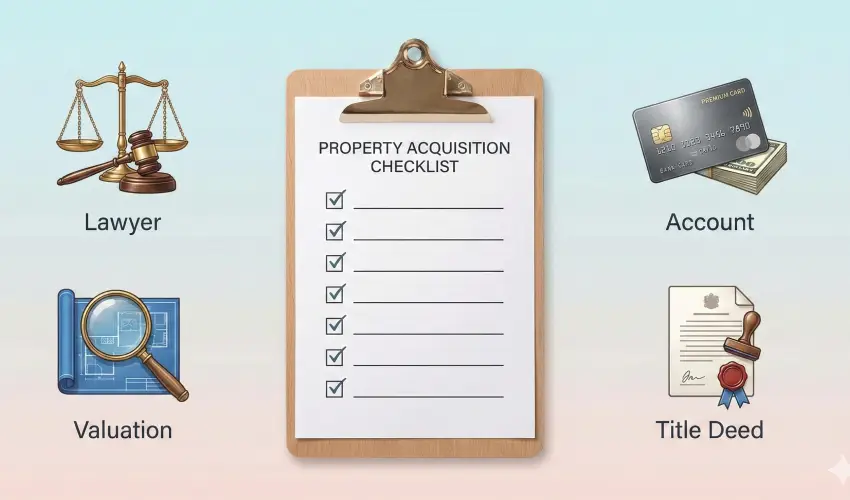
- Independent Counsel: Never use the developer’s lawyer. You need an advocate whose loyalty is to your capital, not the seller's commission.
- Pre-Transfer Bank Clearance: Ensure your bank will open your account and accept your source of funds before initiating an international wire.
- The GEDAŞ Audit: Insist on seeing the official GEDAŞ valuation report before signing any binding sales contract.
- Verification of 'Iskan': Ensure the property has a final habitation certificate (completion certificate). Purchasing off-plan or without Iskan carries significant legal risks in 2026.
- Tax ID Acquisition: This is your first mandatory administrative step in Turkey.
Frequently Asked Questions
1. Can I use Cryptocurrency (USDT/Bitcoin) for the investment?
Not directly. The Turkish Central Bank requires a bank-documented trail for the DAB. You must liquidate your crypto through licensed exchanges and transfer the fiat proceeds through an official bank account. Direct crypto payments to developers are legally void for citizenship purposes.
2. How do I protect against Lira volatility?
While the investment is converted to Lira for the DAB, real estate in Istanbul’s prime districts is effectively USD-pegged. By choosing properties with high "intrinsic value" in premium areas, the capital appreciation typically hedges the currency risk.
3. Are installment plans eligible?
Only if the upfront payment exceeds $400,000 and the title deed is registered in your name immediately. Since most developers do not transfer the deed until the final payment, cash-in-full remains the standard for immediate citizenship.
Final Word: Is the Value Still There?
In 2026, Turkey sells Certainty. In a world of tightening borders and unpredictable "Golden Visa" closures in Europe, Turkey offers a codified and accessible route to a second passport. However, this certainty is only attainable for those who enter the market with a clear understanding of the 2026 digital valuation systems, tax laws, and banking hurdles.
Your capital represents your life’s work. Do not risk it through haste or by following biased advice. If you have the budget and a 5-year vision, Turkey remains a logical and powerful option for wealth protection and global freedom. If you are seeking a 3-year "quick flip," the 2026 tax laws suggest you should look elsewhere.
Disclaimer: This content is for informational purposes only and is not a substitute for formal legal or financial advice.