


 English
 فارسی
فارسی
 العربية
 русский
 USD
USD
 TRY
TRY
 EUR
EUR
 IRR
IRR
 RUB
RUB
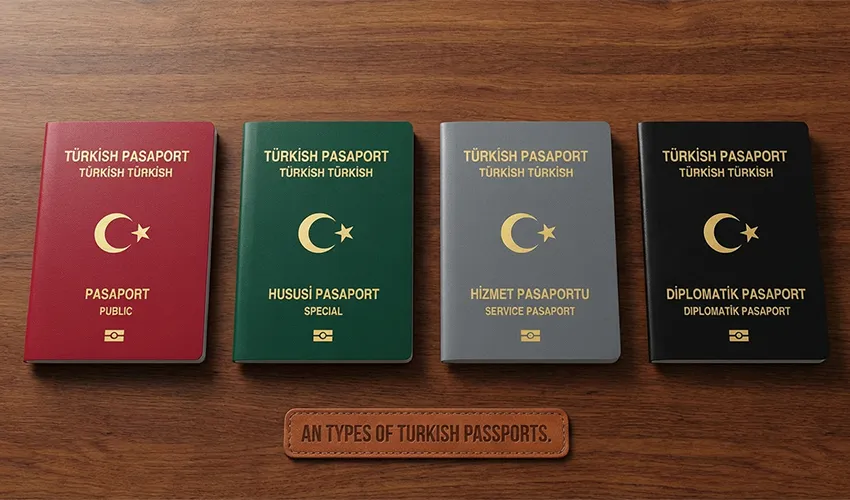
In the system of international law and consular relations, a passport is not just a travel document, but a symbol of national sovereignty, diplomatic standing, and a country's bargaining power on the global stage. The Republic of Turkey, due to its unique position as a bridge between the continents of Asia and Europe, as well as its active role in NATO and its candidacy for European Union membership, possesses one of the most complex and classified passport issuance systems in the world. The subject of "Types of Turkish Passports" goes beyond a mere difference in colors; these distinctions are rooted in Passport Law No. 5682, enacted in 1950, which categorizes society based on government service, diplomatic status, and ordinary citizenship.
For foreign citizens, especially Iranian investors and immigrants seeking capital security and travel freedom, a precise understanding of this legal ecosystem is vital. In 2025, with fundamental changes in government tariffs, new strictness in Citizenship by Investment (CBI) laws, and developments related to European travel authorization systems (ETIAS), the need for a comprehensive resource that examines all these dimensions with an analytical approach based on reliable data is felt more than ever. This report has been compiled in accordance with E-E-A-T principles (Expertise, Experience, Authoritativeness, and Trustworthiness), citing official sources from the Turkish Ministry of Foreign Affairs (MFA), the General Directorate of Population and Citizenship Affairs (NVI), and global indices, to be the final guide for understanding the types of Turkish passports.
A Complete Introduction to the 4 Types of Turkish Passports; What are the Color Differences?
The Turkish passport system, unlike many Western countries that focus primarily on two types (ordinary and diplomatic), features a four-tier structure. This structure reflects Turkey's administrative and social hierarchy, and each passport color grants the holder different consular rights and privileges.
The Red Turkish Passport (Public); Requirements and Benefits
The red passport, referred to in Turkish legal literature as "Umuma Mahsus" (for the general public) and colloquially as the "Bordo Pasaport," is the cornerstone of the international identity system for Turkish citizens.
Who is Eligible for the Red Passport?
This passport is issued to all citizens of the Republic of Turkey who do not qualify for special passports (Green, Gray, or Black). This group includes the vast majority of the population, from private sector workers and employees to students and ordinary retirees. Additionally, foreign nationals who succeed in obtaining Turkish citizenship through investment programs, marriage, or long-term work residency receive this type of passport in the first instance.
Validity Period and Technical Features
The red biometric passports have 38 pages for visas and entry/exit stamps. The validity period varies based on the applicant's request and age:
-
For individuals under 18: Maximum validity is 5 years. The reason for this is the rapid facial changes during growing ages and the need to update biometric photos.
-
For individuals over 18: Validity can range from 6 months to 10 years. Most applicants choose the 10-year option due to cost-effectiveness and reduced bureaucracy.
Travel Power with the Red Passport
Red passport holders require visas to enter the Schengen Area, the United Kingdom, the United States, and Canada. However, by adopting a "Look East" policy and developing relations with South America, the Turkish government has provided visa-free access to major markets such as Japan, South Korea, Singapore, and almost all Latin American countries for holders of this passport.
The Green Turkish Passport (Special); The Key to Visa-Free Travel to Europe
The green passport, or "Hususi" (Private/Special), is one of the most debated and yet powerful travel tools in Turkey. This passport is considered a symbol of social status and a reward for government service, granting the holder privileges that even many European citizens lack.
Requirements for Obtaining the Green Passport (Hususi)
The legislator's goal in creating this category was to facilitate the missions and personal travel of high-ranking government officials so they could travel without being involved in long visa processes. According to Article 14-A of the Passport Law, the following are eligible:
-
Official Government Employees (Memurlar): Those who have attained levels 1, 2, and 3 in the government job classification system (the highest administrative levels based on seniority and education). This includes experienced teachers, state doctors, university professors, and mid-level ministry managers.
-
Former Members of Parliament: Former members of the Grand National Assembly of Turkey (TBMM) who are no longer in power.
-
Exemplary Exporters: Businesspeople whose companies' annual export volume exceeds a certain threshold (determined annually by the Ministry of Trade, usually between $500,000 and $10 million depending on the level). This policy was adopted to encourage exports and foreign currency inflow.
-
Immediate Family: The spouse and unmarried children (up to age 25, provided they are students and unemployed) also benefit from this privilege.
Competitive Advantage: Schengen Visa Exemption
The most important feature of the green passport is the Schengen visa exemption for short-term travel (up to 90 days in any 180-day period). While red passport holders must wait weeks for embassy appointments and document reviews, green passport holders can travel to Germany, France, or any other Schengen member country simply by purchasing a ticket. This stark difference has made the green passport one of the most desirable documents in Turkish society.
The Gray Passport (Service); Specifically for Government Missions
The gray passport, or "Hizmet" (Service), is purely functional in nature and, unlike the green passport, is not considered a personal privilege but a tool for performing duties.
Usage and Limitations
This passport is issued to individuals who do not qualify for Green or Diplomatic passports but are sent abroad for official missions by the government, municipalities, sports federations, or government-affiliated organizations (such as the Turkish Red Crescent - Kızılay).
-
Limited Validity: The validity of this passport corresponds exactly to the duration of the mission and must be returned to the issuing body upon return to the country.
-
Visa Exemptions: Similar to the green passport, this document also allows visa-free travel to Schengen countries and many other destinations.
New Oversight on the Gray Passport
In recent years, following scandals where some municipalities provided gray passports to unrelated individuals to facilitate illegal migration to Europe, the Turkish Ministry of Interior has applied very strict oversight to the issuance of this type of passport. It now requires direct approval from high supervisory authorities.
The Black Passport (Diplomatic); The Highest Rank of Political Prestige
The black passport, or "Diplomatik," as the name implies, is the highest rank of passport in the Republic of Turkey and is issued in accordance with the Vienna Convention on Diplomatic Relations.
Authorized Holders of the Diplomatic Passport
This passport is reserved for top-ranking state officials, including:
-
The President and their deputies.
-
The Speaker of the Parliament and current members of the National Assembly.
-
Ministers, judges of the Constitutional Court and the Supreme Court.
-
Top army generals (Orgeneraller).
-
Ambassadors and professional diplomats of the Ministry of Foreign Affairs and their families.
Special Immunities and Privileges
Holders of this passport enjoy diplomatic immunity, pass through dedicated gates (VIP/CIP) at airports, and are almost never subjected to body or luggage searches in any country. Their visa exemptions are more extensive than any other type of passport and include long-term official travel.
The Cost of a Turkish Passport in 2025; Table of New Prices and Tariffs
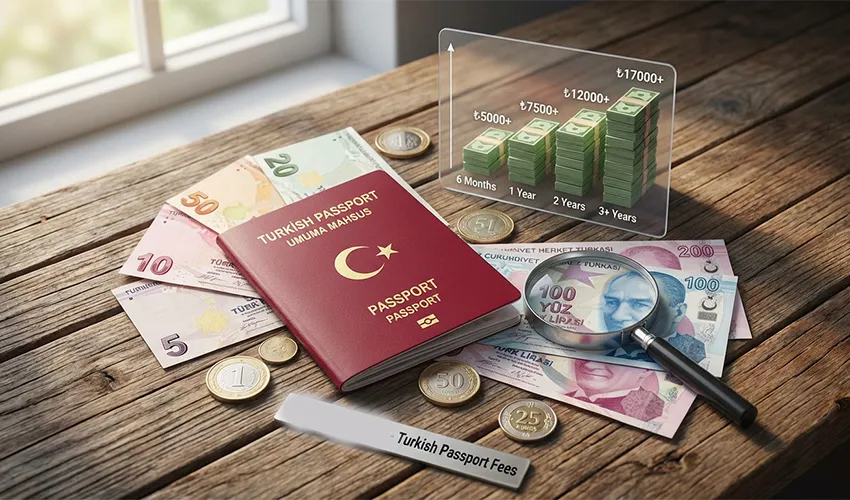
One of the most important aspects of obtaining a Turkish passport is the associated costs, which have undergone significant changes in 2025. In the Turkish economy, many government tariffs increase based on the "Revaluation Rate" (Yeniden Değerleme Oranı), which is determined annually based on the inflation rate. For 2025, this rate was set at approximately 43.93%, leading to a surge in prices.
Structure of Government Costs
The final cost of a Turkish passport consists of the sum of two amounts:
-
Booklet Fee (Defter Bedeli): The amount charged for the physical printing and issuance of the passport booklet, which is fixed for all durations.
-
Service/Tax Fee (Harç Bedeli): A type of government tax that varies depending on the validity period of the passport (from 6 months to 10 years).
Full Table of Turkish Passport Prices (2025)
According to the latest notice published in the Official Gazette (Resmi Gazete) and data from the Population Directorate, the cost table is as follows:
Financial Exemptions for Students and Employees
-
Students: One of the Turkish government's support policies is exempting students (generally under 25) from paying the "Harç Fee." Students are only required to pay the booklet fee (1,135 Lira). This exemption includes educational trips, Erasmus, and even students' personal travels.
-
Green and Gray Passports: Applicants for these passports are also exempt from paying the Harç fee and only pay the booklet fee, as these passports are issued due to job status or government mission.
Steps to Obtain a Turkish Passport; A Step-by-Step Guide to Registration and Documents
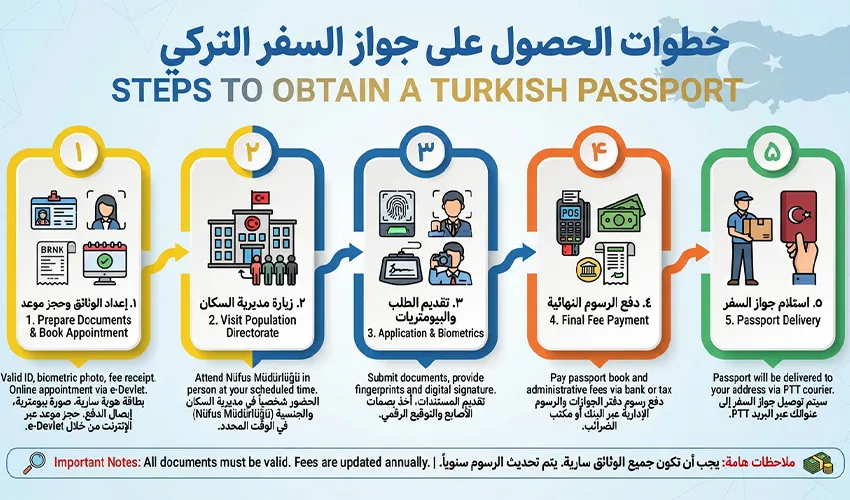
Obtaining a passport in Turkey has become very modern and fast in recent years with the integration of services into the General Directorate of Population and Citizenship Affairs (Nüfus ve Vatandaşlık İşleri Genel Müdürlüğü - NVI). In the past, this duty belonged to the Security Police, but it is now provided as a citizenship service.
How to Apply for a Passport?
-
Booking an Appointment (Randevu): The applicant must first book an in-person appointment through the official website
randevu.nvi.gov.ir, the E-Devlet portal, or by calling 199. -
Gathering Documents:
-
Original new National ID card (T.C. Kimlik Kartı). Using driving licenses or old birth certificates is usually not accepted.
-
One biometric photo taken in the last 6 months (white background, unretouched, 5x6 cm). Photographers in Turkey are fully familiar with the "Biyometrik Vesikalık" standard.
-
Proof of fee payment (although NVI systems are connected online to the banking system, carrying a paper receipt is recommended).
-
Old and expired passports (if any) for physical cancellation.
-
For individuals under 18, the presence of parents and providing a notarized consent form (Muvafakatname) is mandatory, unless both parents are present at the office simultaneously.
-
-
Attendance and Biometric Registration: On the appointed day, the applicant visits the District Population Directorate (İlçe Nüfus Müdürlüğü), and after identification, fingerprints (for those over age 7) and a digital signature are recorded.
-
Postal Delivery: The printed passport is usually sent by the state post (PTT) to the declared address within 1 to 3 business days (in metropolitan areas) and up to 7 days (in remote areas), and it is delivered only to the person themselves or immediate relatives.
Obtaining a Turkish Passport through Real Estate and Investment (2025 Regulations)
The Turkish Citizenship by Investment Program, launched in 2017, is one of the most successful migration programs in the world. It provides a direct path to obtaining a Turkish passport (usually the red type) without the need for prior residency. However, the laws of this program have undergone fundamental changes in recent years.
Evolution of the Minimum Investment Amount
-
2017: Program started with a minimum investment of $1 million in real estate.
-
2018: Dramatic reduction of the amount to $250,000, leading to an influx of investors.
-
2022 to 2025: Minimum property purchase amount increased back to $400,000 USD due to housing price inflation and domestic reactions.
Legal Methods to Obtain Citizenship in 2025
According to the implementing regulations of the Turkish Citizenship Law, the following methods are valid for obtaining a passport:
-
Real Estate Purchase:
-
Amount: Minimum $400,000 USD.
-
Holding Condition: The purchased property must have a "No-Sale Annotation" (Satılamaz Şerhi) for 3 years on the official deed (Tapu).
-
New 2025 Challenges: Scrutiny of appraisal reports (Ekspertiz Raporu) has become very intense. The government only accepts reports from its trusted companies to prevent overvaluation. Also, the property must not have been previously used by another foreigner for citizenship.
-
Foreign Exchange Purchase Certificate (DAB): The buyer must convert foreign currency into Lira and receive the DAB certificate (Döviz Alım Belgesi) from the bank; direct dollar payment to the seller is prohibited.
-
-
Bank Deposit:
-
Amount: Minimum $500,000 USD (or equivalent).
-
Conditions: Deposit in one of the active banks in Turkey for 3 years with a commitment not to withdraw the principal. Bank interest belongs to the investor and is withdrawable.
-
YUVAM Accounts: The Central Bank of Turkey offers protected deposit accounts (Kur Korumalı) to encourage this method, which, in addition to bank interest, guarantees the dollar principal against the depreciation of the Lira.
-
-
Other Methods:
-
Purchase of government bonds worth $500,000 with a 3-year maturity.
-
Investing $500,000 in Real Estate Investment Trusts (REIT) or venture capital funds.
-
Creation of permanent employment for at least 50 Turkish citizens with approval from the Ministry of Labor and Social Security.
-
Restricted Areas in Istanbul for Property Purchase (Red List)
One of the most vital points for applicants in 2025 is paying attention to the list of "Closed Neighborhoods." The Turkish Ministry of Interior has banned residency and address registration in 1,169 neighborhoods across the country to control foreign population density.
-
Istanbul: Popular areas like Esenyurt, Fatih, Beyoğlu, and Şişli have numerous neighborhoods on the red list.
-
Risk: If a property is purchased in these areas, the deed may be issued, but residency (Ikamet) will not, which could disrupt the family's citizenship process. Verifying the neighborhood status before purchase is mandatory.
Changing Name on the Turkish Passport; A Unique Opportunity
One unique feature of Turkish nationality laws (Law No. 1353) is the possibility to completely change your first and last name upon receiving citizenship.
-
Opportunity: The applicant can choose a fully Turkish name (e.g., changing "Mohammad" to "Mehmet" or choosing a new name like "Aras") or maintain their foreign name in Latin letters.
-
Limitations: The chosen name must not include characters not present in the Turkish alphabet (such as W, Q, X) and must not exceed two words. This name change is registered in the Official Gazette and the person's new identity becomes official in the Turkish banking and administrative systems.
Which Countries Can You Visit with a Turkish Passport? (Visa-Free List)

The true value of a passport lies in the travel freedom it provides the holder. 2025 analyses show that the Turkish passport is on a growing path.
Global Ranking of the Turkish Passport in 2025
At the start of 2025, the Turkish passport has reached 46th globally, climbing 6 spots. This improvement is due to new visa-waiver agreements and diplomatic openings. Ordinary Turkish passport holders can travel to 116 to 126 destinations (depending on the statistical source) visa-free, with a visa on arrival, or an e-visa.
Strategic Visa-Free Destinations
-
Asia and Oceania: The Turkish passport is the golden key to East Asia. Countries like Japan (90 days), South Korea (90 days), Singapore (30 days), Malaysia (90 days), Thailand, and Hong Kong are all visa-free. This level of access is unparalleled for a Middle Eastern passport and provides massive business opportunities.
-
Latin America: Almost all South and Central American countries (Brazil, Argentina, Chile, Colombia, Panama, etc.) have full visa waivers. This region is accessible to Turkish citizens for tourism and business without any barriers.
-
Europe (Non-Schengen): Countries in the Balkan region (Serbia, Montenegro, Bosnia, Albania, North Macedonia) and Eastern Europe (Belarus, Moldova, Ukraine) are visa-free.
Schengen Visa Status and the ETIAS System
The biggest challenge for the ordinary Turkish passport is the lack of visa-free access to the Schengen Area.
-
Current Status: Ordinary citizens require a Type C visa to enter the European Union.
-
ETIAS System (European Travel Information and Authorisation System): This new system is not a visa but a travel pre-authorization for citizens of visa-exempt countries (like the US or Japan).
-
Major Clarification: There were rumors that Green Turkish passport holders must obtain ETIAS. However, the EU Delegation to Turkey has officially stated that Turkish citizens (including holders of Green, Gray, and Black passports) are exempt from the ETIAS system. The technical reason is that Turkey is not on the EU's "Visa-exempt" list; thus, red passport holders continue to get visas, and special passport holders (who are exempt under bilateral treaties) travel simply by presenting their passport without needing to register in ETIAS.
Blue Card (Mavi Kart) and Dual Citizenship Laws in Turkey
Turkey is a country that recognizes dual citizenship. This means that foreign citizens do not need to renounce their original citizenship after receiving a Turkish passport (unless their home country mandates it).
What is the Blue Card (Mavi Kart) and What is its Use?
Some countries (like Germany in past laws or Austria) do not allow dual citizenship. Turkish citizens living in these countries had to renounce their Turkish citizenship to obtain the host country's citizenship. The Turkish government created the "Blue Card" to maintain legal links with this diaspora.
-
Holder's Rights: Blue Card holders have almost all Turkish citizenship rights: permanent residency, the right to work without a permit, the right to buy and sell property, inheritance rights, and the use of banking and educational services.
-
Difference from Full Citizenship: They are only deprived of 4 political and sovereign rights:
-
The right to vote and run in elections.
-
Performing compulsory military service.
-
Employment in official government posts (Memur) that require national security clearance.
-
The right to import vehicles with specific citizenship exemptions.
-
This card is a vital tool for those who have been forced to renounce Turkish citizenship for legal reasons, and it remains strongly in place in 2025.
Final Word: Which Turkish Passport is Right for You?
A comprehensive review of the types of Turkish passports in 2025 shows that this identification document is a multifaceted tool with different functions.
-
For Ordinary Citizens and Investors: The Turkish red passport, although not yet the key to Schengen gates, serves as one of the most powerful passports in the region, providing unparalleled access to Asian economic hubs and emerging Latin American markets. The $400,000 investment, despite the price increase, remains a fast and reliable path to obtaining this global identity and enjoying its benefits.
-
For Administrative Elites: The system of green and black passports provides a form of "lifetime Schengen visa" for a specific segment of society, maintaining Turkey's diplomatic advantage even in tough political conditions. The ETIAS exemption demonstrates the continuity of this special privilege.
-
Future Outlook: Due to the inflation of government tariffs and property-related strictness, obtaining a Turkish passport is becoming more of a luxury commodity. However, the stability of dual citizenship laws and strong consular infrastructure keep it an attractive option for Iranians and international investors.
This report confirms that the Turkish passport, beyond the color of its cover, is a document that puts the geopolitical weight of this country in the pockets of its citizens.