



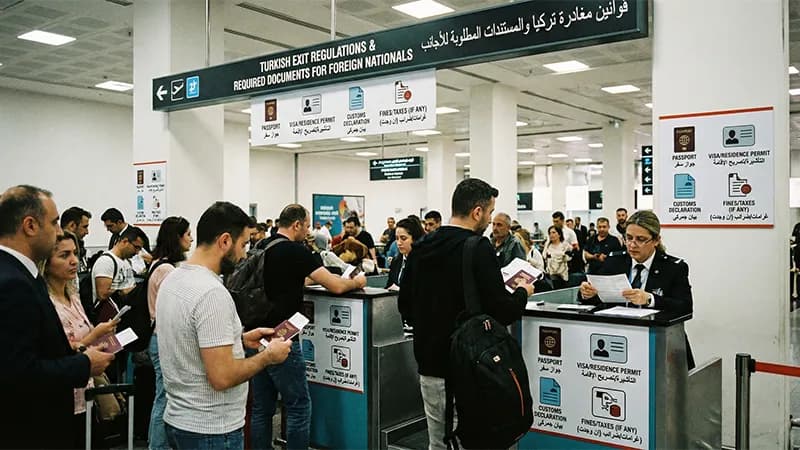
Fundamental changes in the immigration and oversight policies of the Republic of Turkey between 2025 and 2026 have outlined a new legal landscape for foreign nationals. Exiting Turkey's borders is no longer a simple administrative process; it requires a deep understanding of a complex network of customs, tax, security, and immigration laws influenced by economic fluctuations and national security necessities. For those who have recently invested in a property in Istanbul and are navigating residency or citizenship applications, understanding these rules is critical. This report, using an expert yet accessible approach, explores all aspects of legal departure from Turkey from the perspective of Google standards to ensure that travelers and foreign residents manage their exit process with minimum risk.
Exiting Turkey incorrectly can jeopardize your residency or citizenship. Invest in Turkish real estate with Istaproperty, and our legal experts will ensure your travel never interferes with your application. → Explore Safe Investment Opportunities.
Required Documents for Exiting Turkey and Passport Requirements
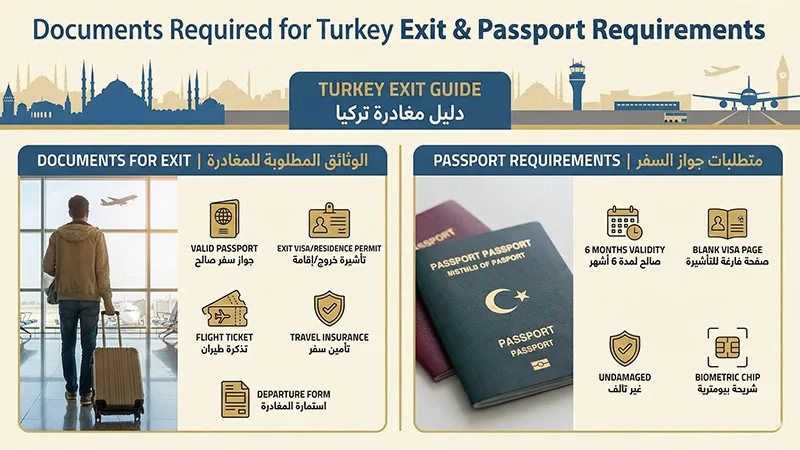
The cornerstone of any legal exit is having valid identification documents defined not only by the Turkish government but also by international treaties. According to Article 7 of Law No. 6458 on Foreigners and International Protection, every foreign national is obliged to present their passport or a valid substitute document upon departure.
Passport Validity and Physical Condition
In 2026, Turkish border authorities emphasize the "6-month rule." While some bilateral agreements may allow for fewer restrictions, the general and standard recommendation to avoid being barred from leaving or facing issues in the destination country is to have at least 6 months of validity remaining from the time of departure. Physical defects in passport pages can also become a serious challenge; the passport must have at least two blank facing pages for future exit and entry stamps.
The Importance of Exit Stamps and Systematic Registration
Receiving an exit stamp in the passport is not merely a physical formality; it is a legal document confirming the end of the stay in Turkey. Failure to correctly register the departure in the border police computer systems can lead to charges of "illegal stay" or "unofficial departure" in future visits, resulting in heavy fines or entry bans. For individuals holding a residence permit (Kimlik), presenting the physical card alongside the passport is mandatory so that their stay is not deducted from the 90-day tourist quota.
Table: Document Status Based on Traveler Type
Traveler Status |
Main Exit Document |
Mandatory Supplementary Document |
|---|---|---|
Regular Tourist (Visa-Free) |
Valid Passport |
Return Ticket and potential fine receipts |
Residence Permit Holder (Ikamet) |
Valid Passport |
Physical Residence Card (Kimlik) |
Renewal Applicant (Waiting for Card) |
Valid Passport |
Appointment Confirmation + Payment Receipt |
Traveler with Lost Passport |
Travel Document (Barg-e Oboor) |
Official Police Report and Consulate Code |
Turkey Customs Laws 2026: Limits on Currency, Lira, and Gold
To control inflation and manage capital flight, the Turkish government has implemented significant changes in 2026 regarding the maximum amount of cash allowed for export. These changes reflect a stricter approach toward foreign currency while providing relative facilitation for the national currency (Lira) for intermediate amounts.
Cash Exit Limits: Lira and Foreign Currencies
According to recent circulars, the limit for exporting Turkish Lira cash, which was 25,000 Lira for years, has seen a significant jump to 185,000 Lira. This action aims to align with the national currency's devaluation and travelers' needs for daily expenses. However, for amounts exceeding 185,000 Lira, travelers must complete a "Cash Declaration Form" (Nakit Beyan Formu).
Conversely, laws regarding foreign currencies (Dollar, Euro, etc.) remain unchanged, with the limit for undeclared export set at 10,000 Euros. Exporting amounts exceeding this by non-residents is only permitted if the individual can prove they declared this amount upon entry or provides bank documentation of currency purchase from legal sources in Turkey.
Exporting Jewelry and Precious Metal Items
As a gold trade hub, Turkey has specific laws for exporting personal jewelry. Travelers can export personal (non-commercial) jewelry up to a value of $15,000 USD without declaration. If the value exceeds this, an official purchase invoice or initial entry documentation is mandatory. Otherwise, customs may treat the items as commercial goods, subject to tax or seizure.
Table: Financial and Commodity Exit Restrictions
Asset Type |
Undeclared Limit |
Action for Excess Amounts |
|---|---|---|
Turkish Lira (Cash) |
185,000 Lira |
Complete Customs Declaration Form |
Foreign Currency (USD/EUR) |
10,000 Euro (or equivalent) |
Present Entry Declaration or Bank Receipt |
Personal Jewelry |
$15,000 USD |
Entry registration in passport or Invoice |
Gifts and Souvenirs |
Up to 500 Euro (approx. value) |
Present purchase receipt for expensive items |
Overstay Penalties in Turkey: Calculation and Visas
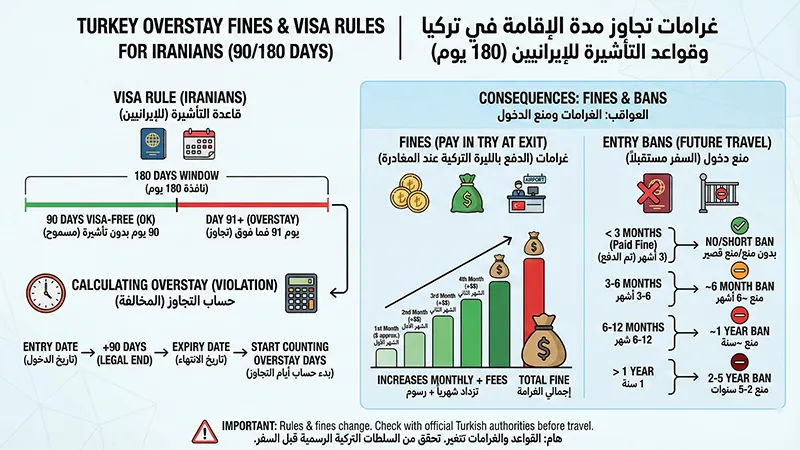
For many citizens, Turkey is a destination allowing a 90-day visa-free stay in any 180-day period. However, this ease has increased the risk of "Overstaying." Understanding the calculation mechanism for these 90 days is vital to avoiding fines and entry bans.
The Rolling 180-Day Window Mechanism
The Turkish border police system uses a "Rolling Window" calculation model. This means that on the day of departure, the system looks back at the past 180 days; if the total days of presence exceed 90, a visa violation has occurred. Many travelers mistakenly believe that a quick exit and entry (visa run) resets their 90-day period, but this is strictly monitored by the Migration Management (Göç İdaresi).
Fine Payment Process at Istanbul Airports
If an individual has overstayed, their exit process deviates from the normal route and requires a visit to the "Visa Violation Office." At Istanbul Airport (IST), this unit is located near the passport control gates.
1. Boarding Pass: The traveler must first check in their luggage and receive their boarding pass. 2. Fine Calculation: By presenting the passport and boarding pass, the fine amount is calculated based on nationality and duration of overstay. 3. Cash Payment: Fines are only accepted in cash and in Turkish Lira. No foreign bank cards or other currencies can be used at these counters. 4. Completion: After payment and receiving a receipt, the traveler returns to the passport control line for the final exit stamp.
Don't Let Overstays Cancel Your Dreams
Whether you're battling overstay fines or worrying about absence rules, our legal experts ensure your path to Citizenship or Residency remains intact.
Speak with an Immigration & Property LawyerExit Rules for Kimlik Holders and the Citizenship Application Process
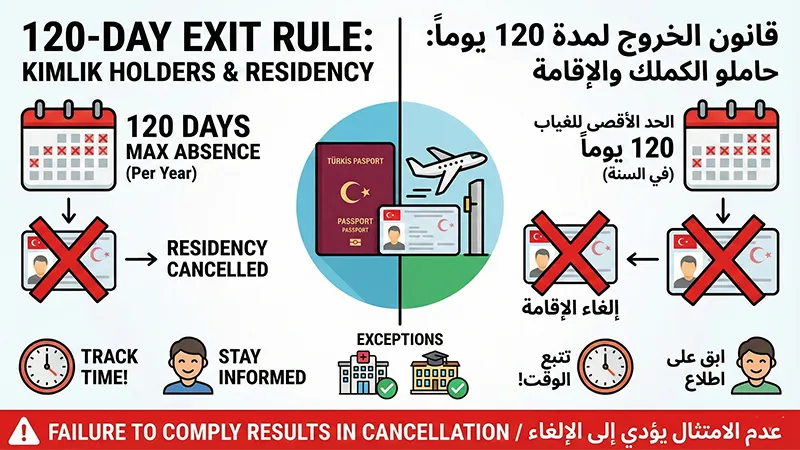
The Turkish government's new policies in 2026 have imposed stricter limits on tourist and work residence holders intending long-term departures. Furthermore, major questions arise for foreign investors regarding travel constraints.
The 120-Day Rule and Residency Revocation
One of the most critical regulations that expats search for is the turkish residence permit absence rules 120 days. According to this rule, if a short-term residence permit holder spends more than 120 days outside Turkey in a calendar year, they face the risk of turkish residence permit cancellation absence 120 days. The Migration Office has the right to revoke their residence permit. In such cases, the individual is treated as a "regular tourist" upon return and must go through the entire residency application process again with stricter oversight.
Leaving Turkey During Turkish Citizenship Application Processing
For investors acquiring property, a massive point of anxiety is travel flexibility. People frequently ask our lawyers: can you leave turkey during turkish citizenship application processing? The straightforward answer is yes, you can. But many still wonder, can i leave turkey during turkish citizenship application processing without facing delays?
During the turkish citizenship application process waiting period can applicant leave turkey safely? Yes, as long as the applicant maintains a valid underlying status (like an investor residence permit) and follows standard exit laws. It is completely legal. If you are asking, can you leave turkey while turkish citizenship application is pending, there are no specific borders locking you in. The main concern is whether leaving turkey during citizenship application waiting period affects the processing time. As long as your lawyer is handling your file locally, leaving turkey during citizenship application processing does not disrupt it.
Some clients panic and ask: does leaving turkey cancel citizenship application? Absolutely not. While the turkish citizenship application waiting period can leave country rules are favorable, the government still requires you to have a valid address registered in Turkey. Therefore, leaving turkey during turkish citizenship application process is fine, but you should not abandon your legal residence. So, to answer definitively: can foreigner leave turkey during turkish citizenship application processing or can turkish citizenship applicants leave turkey during processing? Yes, the turkish citizenship application processing can applicant leave turkey policies allow for international travel, provided you have your Ikamet card with you at passport control.
Exiting During the Waiting Period and the 15-Day Permission
For individuals who have had their appointment but haven't received their physical Ikamet card yet, exiting Turkey is high risk. They are only permitted to exit with a certified "Residence Permit Application Document" on the condition of returning within a maximum of 15 days. Exiting for more than 15 days at this stage is considered a withdrawal of the application and results in file cancellation.
Address Registration and Legal Exit
Turkey's oversight system now links the exit of foreign nationals to "Address Registration" (Adres Kaydı). Foreigners are obliged to report any address change within 20 working days. At exit points, if the system shows that the individual has not registered their address or their address is invalid, they may face secondary questioning or administrative fines.
Lost Passports in Turkey: Obtaining a Travel Document from the Embassy
Losing a passport in a foreign country can be a stressful experience, but Turkish laws provide a clear path. Without a passport, exiting Turkish air or land borders is absolutely impossible.
Lost Passport Protocol and Obtaining a Travel Document
The first action in case of a lost passport is to visit the nearest police station (Polis Merkezi) to file a lost or stolen property report. This report must be officially stamped, as it is the only document that distinguishes your exit from an "illegal entry" status.
After receiving the police report, the national must apply for a "Travel Document" through their consulate's system. With the tracking code and biometric photos, an in-person visit to the Consulate in Istanbul or Ankara is mandatory. The travel document is usually valid for 20 days and only for a direct return to the home country; it cannot be used for travel to a third country or for transit tickets.
Rules for Exporting Vehicles, Pets, and Valuables (Antiques)
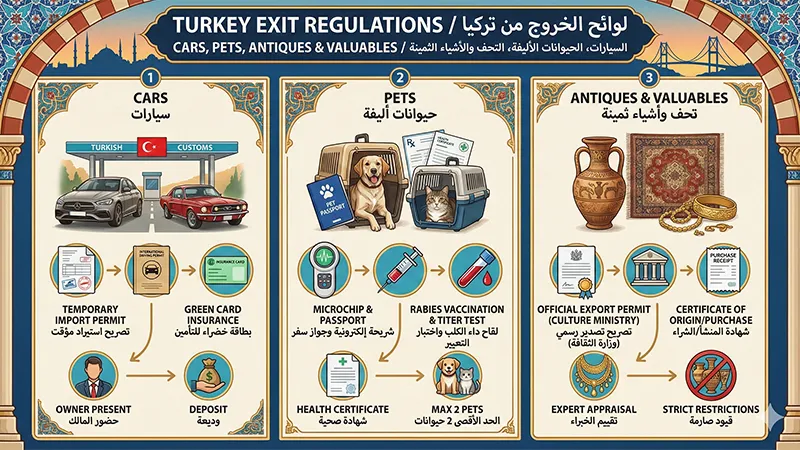
Exporting certain items from Turkey is subject to strict customs and security supervision. Ignoring these laws can lead to serious charges such as "Smuggling" or "Destruction of Cultural Heritage."
Exiting with a Foreign-Plated Vehicle (Temporary Entry)
Travelers who entered Turkey with a personal vehicle face a serious challenge when leaving without it. Turkish law does not allow a person who imported a vehicle to leave the country without it, unless they deposit the vehicle in customs-approved parking lots (usually at airports) and notify the customs office. A commitment must be signed that no one will drive the vehicle in their absence. Violation can lead to fines several times the vehicle's value.
Absolute Ban on Exporting Historical Artifacts and Antiques
Turkish laws regarding cultural heritage are extremely strict. Exporting any object with historical age (even old stones or pieces found at archaeological sites) is prohibited. For items like hand-woven carpets or copper objects with an antique appearance, travelers must obtain an "Export Certificate" or museum confirmation showing the object is not protected national heritage. The penalty for attempting to smuggle antiques is long-term imprisonment.
Exporting Pets and Health Requirements
Exporting dogs, cats, or pet birds requires a microchip, an international health certificate, and a valid rabies vaccination certificate. Additionally, the traveler must take the animal to the District Agriculture and Forestry Directorate (Tarım ve Orman İl Müdürlüğü) no more than 48 hours before the flight to receive an "Exit Health Certificate." Each traveler is allowed to export a maximum of two pets.
Tax Debt Inquiry and Exit Fee Payment in Turkey
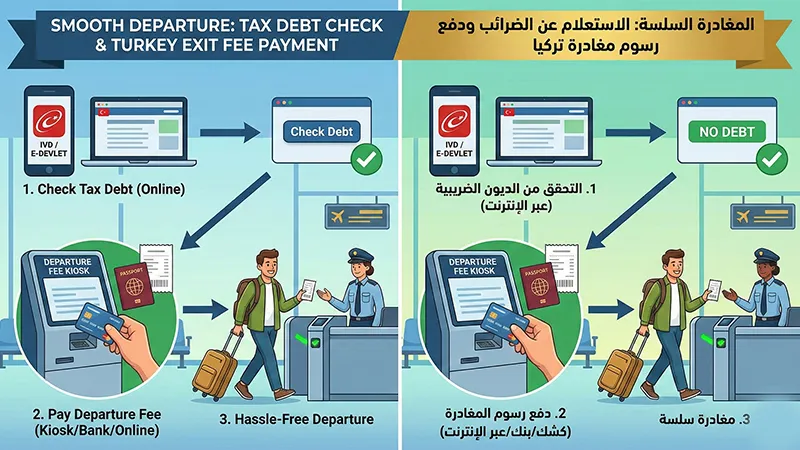
In Turkey's smart border system of 2026, the exit of foreign nationals is tied to their "debt status" with the government. Tax debts, unpaid traffic fines, and even debts to state hospitals can become barriers to departure.
Traffic Fines and Tolls
Many travelers face unpaid traffic fines at departure. It is recommended to check the vehicle plate or National ID (for residence holders) status in the "Interactive Tax Office" system before heading to the airport. Fines not paid on time incur a 5% monthly late penalty. Paying these at the airport can be time-consuming and may result in missing a flight.
Departure Fee for Residents and Nationals (Yurt Dışı Çıkış Harcı)
Turkish nationals and those identified as "residents" in the tax system are required to pay a "Departure Fee." This amount will increase significantly to around 1,255 Lira for 2026. This fee can be paid via dedicated ATMs at the airport or bank counters in the departure hall. Regular tourist travelers are not subject to this fee.
Exit Bans in Turkey: From Social Media to National Security
In recent years, the Turkish government has applied specific sensitivities regarding foreign nationals' activities in virtual space. According to official consular warnings, harsh criticism of the Turkish government or officials on social media can lead to charges such as "insulting national values," resulting in arrest at exit or an "Exit Ban" until the end of legal proceedings.
Also, presence in illegal political protests or proximity to border military zones can lead to passport seizure and revocation of residency upon exit. Travelers should always keep a copy of their passport and residence card to avoid issues during airport security checks.
Changes in Exit Laws in Turkey for 2026: Smart Systems
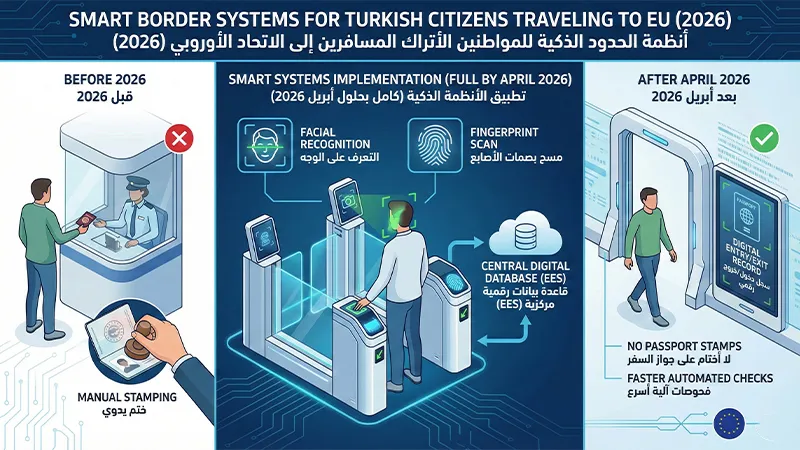
Current trends show that by 2026, Turkey is moving toward fully eliminating physical counters for certain services, replacing them with biometric systems and mobile apps.
1. Strictness in Tourist Renewals: Under new 2026 laws, residency renewals based on "tourism" are rarely accepted, and travelers must provide a detailed itinerary and stronger financial proof before exiting. 2. Digital Appeals System: If a deportation order is issued, foreigners now have 7 days to appeal via their lawyers in administrative courts. The good news is that in 2026, filing an appeal automatically prevents the execution of the deportation until a final verdict is reached (Suspensive Effect). 3. Closed Neighborhood Control: The list of "Closed Neighborhoods" for foreign residence has increased to over 1,160. Those staying unofficially in these areas will face heavy fines and a permanent revocation of residency rights upon exit.
Invest with Peace of Mind
When you buy property with Istaproperty, our legal experts ensure your citizenship files and travel movements perfectly align with Turkish laws. Travel globally while we handle your paperwork locally.
Get a Free Property & Immigration ConsultationFinal Recommendations for Hassle-Free Exit from Turkey
Exiting Turkey in 2026 requires attention to details previously overlooked. Strict adherence to the 185,000 Lira cash limit, ensuring stay does not exceed 90 days in a 180-day window, and awareness of the 120-day exit rule for residents are the three pillars of a hassle-free trip. Final advice is to arrive at the airport at least 4 hours before your flight, especially if you suspect you have fines or government debt. Do not leave payments to the last minute and always carry some cash Lira for unexpected customs fees, as airport penalty systems still rely heavily on cash. Following these protocols ensures your stay and exit are not only legal but also guarantee your ability to return in the future.