



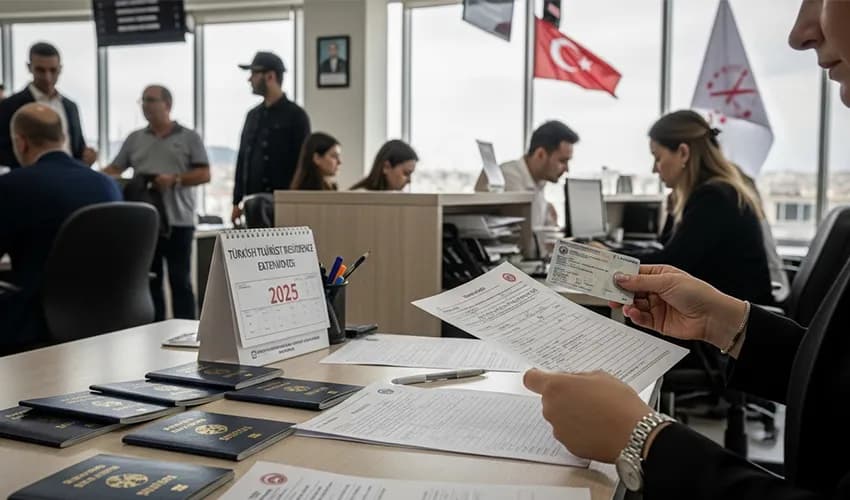
Fundamental Transformation in Turkey's Immigration Policies
At the beginning of 2025, the immigration landscape in Turkey, particularly concerning the **"Tourist Residency"** (Kısa Dönem Turizm Amaçlı İkamet İzni), has undergone structural and fundamental changes. What was known in the past decade as a routine and easily accessible administrative process has now turned into a complex, multi-layered supervisory mechanism based on selectivity. This report is designed to precisely dissect these changes, review the new legal obstacles, and provide a specialized roadmap for residency renewal applicants. Analysis of existing data from the Directorate General of Migration Management (Göç İdaresi) circulars, rules registered in the Official Gazette (Resmi Gazete), and judicial practices indicates that the Turkish government is transitioning from an **"open-door"** policy to a **"qualitative and regulated migration"** policy.
It is vital to understand that tourist residency is no longer considered a right for every foreigner who rents a property. The changes implemented in Articles 31 and 32 of the Law on Foreigners and International Protection (YUKK) and the introduction of systems like **UETS** indicate Ankara's serious commitment to controlling the non-active migrant population and increasing social security. This report will analyze all dimensions of this process—legal, administrative, and financial—across seven main chapters.
New Turkish Residency Laws in 2025; Why Has Renewal Become Difficult?
Important Changes in the Interpretation of Article 32 (Rejection of Applications)
The cornerstone of foreign nationals' residency in Turkey is Law No. 6458. However, the interpretation of these texts by law enforcement officials has changed in 2025. Specifically, **Article 32**, which addresses the "conditions for rejection, cancellation, or non-renewal of residency," is now enforced with unprecedented strictness. In the past, merely providing a rental contract (even a pro-forma one) was sufficient to prove the "purpose of stay." But in the new 2025 doctrine, migration officers are obliged to verify the **"actual purpose"** (Purpose of Stay). If an applicant requests a tourist residency renewal for consecutive years (e.g., more than one term) without providing a justified reason for continuing tourism, their file will be rejected under the premise of **"non-compliance with the purpose of stay."**
Legal analysts point out that migration authorities now use their **"legal discretion"** (Takdir Yetkisi) more broadly. This means that even if the documents appear complete, if the case officer is not convinced that the applicant is purely a tourist (and, for example, is not engaging in illegal work), they can reject the application. This approach is more evident in heavily populated provinces such as **Istanbul and Antalya**, where demographic capacity is saturated.
The 120-Day Rule and the Condition of Presence in Turkey
One of the points that has gained double importance in 2025 is the rule of **physical presence**. Although the strict rule of residency cancellation for leaving the country for more than 120 days a year was previously moderated, new sources indicate that continuous presence in Turkey is one of the indicators for measuring the **"genuineness of residency"** for renewal. If an individual has been outside of Turkey for more than 120 days in the past year, they may face challenges during renewal, as this long absence can be interpreted as a lack of actual need for residency in Turkey. Applicants must be aware that tourist residency is issued for **"living in Turkey,"** not as a **"long-term travel visa"** for occasional transit.
The New UETS Law and Notarized Rental Contracts; Vital Changes You Need to Know
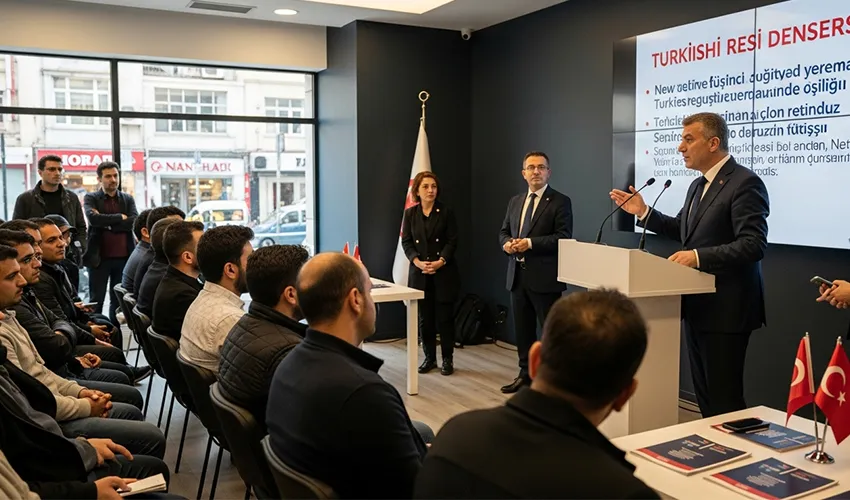
2025 is a turning point in the digitalization and surveillance of the residency process. Two major structural changes—the **Electronic Notification System (UETS)** and the new requirements for rental contract registration—are the main bottlenecks for residency renewal.
Obtaining the UETS Code for Foreigners (Mandatory)
Since April 2024, and with increasing intensity in 2025, providing a **UETS (Ulusal Elektronik Tebligat Sistemi)** address has become mandatory for all residency renewal applicants. This system, supervised by the Turkish Post and Telegraph Organization (PTT), has replaced traditional paper notifications.
**Why is UETS essential?** In the past, many migrants did not receive rejection rulings (Red) or requests for document completion due to address changes, unintentionally entering the illegal phase (**Kaçak**). The UETS system ensures that all legal and administrative notifications reach the applicant instantly and legally. According to Article 7201 of the Notification Law, any message sent to the UETS mailbox is considered **"delivered"** after 5 days, even if the applicant does not open it.
**How to Obtain UETS:** Unlike Turkish citizens, resident foreign nationals cannot simply obtain this code entirely online (unless they have an electronic signature, E-Imza). The standard process for foreigners involves the following steps:
-
**In-Person Application:** The applicant must personally visit one of the central PTT branches (not small desks).
-
**Required Documents:** Original passport, valid residency card (with ID number 99), a mobile phone registered in the person's name, and a valid email address.
-
**Completion of the Commitment Form:** Filling out the **"UETS Liability Document"** which places the responsibility for checking the message box on the applicant.
-
**Receipt of Account Form:** Finally, an A4 sheet containing the UETS address and account information is issued. **Submitting this physical sheet to the migration office on the interview day is mandatory,** and merely having the code is not sufficient.
**Important Note:** Applicants whose residency cards have expired and are within the 10-day grace period or the renewal process may face difficulty obtaining UETS from the PTT, as the PTT system requires a valid card. Therefore, the strong recommendation is to apply for UETS before the current card expires.
Goodbye to Pro-Forma Rental Contracts; The Rule of Landlord Presence at the Notary
Perhaps the most challenging change for renewal applicants is the strict rules regarding the place of residence. The era of drafting manual rental contracts at real estate agencies or even notarizing contracts without the owner's presence has ended.
**New Rental Contract Conditions 2025:**
-
**Owner's Presence at the Notary (Noter):** According to new circulars, for the rental contract to be valid with the migration office, the lessor (landlord) **must personally appear** at the notary's office. If the owner cannot attend, their legal representative must be present with an official power of attorney.
-
**"Düzenleme" Format:** The rental contract must be prepared in the official **"Düzenleme Şeklinde"** format. This is the highest level of document validity in Turkish law and fundamentally differs from previous contracts that were merely **"signature confirmation"** (Onaylama).
-
**Key Phrase:** The notarized rental contract must explicitly contain the phrase **"...huzurumda alındığını onaylarım"** (I confirm that it was obtained in my presence), which must be inserted by the notary public. This phrase signifies definite identity verification of the parties.
-
**Population Registration (Numarataj):** In addition to the rental contract, the applicant must obtain the **"Numarataj"** document from the local municipality, which shows that the residential unit actually exists in the National Address Database System (UAVT) and is zoned for residential use. This action prevents registering addresses on commercial units, warehouses, or unfinished buildings.
**Banned Districts (Mahalle Kısıtlaması):** The policy of **"closing neighborhoods"** remains in effect. Over 1,169 neighborhoods across Turkey (including large areas in Esenyurt, Fatih, Şişli in Istanbul, and Konyaaltı, Liman in Antalya) are blocked for new registrations and sometimes even for address changes during the renewal process. If a renewal applicant has changed their address from an open area to a closed area, their application will be rejected. The list of these areas changes dynamically and must be checked before signing a contract.
Financial Solvency and the Cost of Turkish Residency Insurance in 2025: How Much Is It?
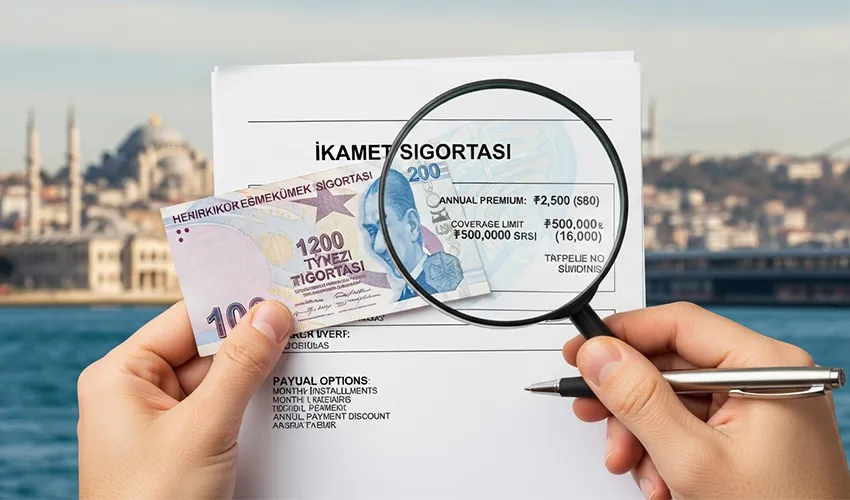
Due to the inflation rate and the increase in the minimum wage in Turkey, the financial standards for residency acceptance have drastically increased. The migration office wants to ensure that the foreign tourist will not be a burden on Turkey's social system. [Image of Turkish Lira currency and bank statements]
Required Financial Solvency Amount (Maddi İmkan)
In 2025, simply stating income verbally in the application form is not enough. Migration officers have the authority and usually request that the applicant provide documented evidence.
-
**Assessment Criterion:** The basis for calculation is the monthly **minimum wage (Asgari Ücret)**. For 2025, the gross minimum wage has been set at approximately 26,005 TL and the net amount at around 22,104 TL. The applicant must show that they have at least the equivalent of this amount (and sometimes 1.5 times that) in their account for each month of residency.
-
**Bank Account Turnover:** Submitting a 6-month bank statement printout is mandatory. The critical point is that a lump-sum deposit of a large amount (colloquially called **"account window dressing"** or "hesap makyajı") one day before the interview is identified by officers and is not only rejected but can lead to application rejection due to "lack of honesty." Account turnover must show actual living expenses (market purchases, bill payments, rent) to prove that the individual genuinely lives in Turkey.
Price of Foreign Health Insurance (Sağlık Sigortası)
Having valid health insurance that covers the entire requested residency period is one of the main conditions.
-
**Types of Insurance:** Applicants can use private insurance (**Özel Sağlık Sigortası**) or state insurance (SGK). Most tourist applicants use private insurance, which must include the phrase: **"This insurance covers the minimum required conditions for residency."**
-
**Price Increases:** Insurance tariffs have increased in 2025. These prices vary based on the applicant's age. For example, insurance for the 18-25 age group is cheaper than for the 46-50 age group.
-
**Estimated Insurance Cost Table (2025):**
Age Group |
Estimated One-Year Cost (TL) |
Estimated Two-Year Cost (TL) |
|---|---|---|
18 to 25 Years |
3,000 - 4,500 |
5,000 - 7,500 |
26 to 35 Years |
3,500 - 5,000 |
6,000 - 8,500 |
36 to 45 Years |
4,500 - 6,500 |
8,000 - 11,000 |
46 to 55 Years |
6,000 - 9,000 |
10,000 - 15,000 |
Over 65 Years |
Special Conditions / Very Expensive |
Special Conditions |
Step-by-Step Guide to Residency Renewal and Complete Document Checklist
The residency renewal process is a race against time and requires accuracy. Any mistake at this stage can lead to a deficiency code (**Eksik Evrak**) or complete rejection.
The Golden Timing (The 60-Day Rule)
You are only permitted to enter the system and apply for renewal in the window of **60 days remaining before the expiration of your current card.**
-
**Warning:** The application **must** be submitted **before** the current card expires. If the card's validity ends and you have not registered, you enter the phase of penalty and deportation.
-
After registration, you receive a **"Reference Document"** (Müracaat Belgesi) which allows you to legally remain in Turkey until the interview (even if your card expires).
Final Document Checklist for the Appointment Day (2025)
According to the latest observed procedures and official sources, the following documents must be arranged in a folder (usually pink):
-
**Application Form Printout (E-Ikamet):** Hand-signed with a blue pen on the last page.
-
**4 Biometric Photos:** White background, recent (less than 6 months), without heavy retouching.
-
**Original and Copy of Passport:** Copy of the first page, the page with the visa/latest entry stamp. The passport must be valid for at least 60 days longer than the requested residency period.
-
**Current Residency Card:** Original card and color copy of both front and back.
-
**UETS Document:** Printout of the user account sheet received from PTT.
-
**Proof of Residence:**
-
Notarized rental contract (with the owner's presence and the confirmation phrase).
-
Numarataj document from the municipality.
-
Yerleşim Yeri document (If the address is registered in the population system, it can be printed from E-Devlet).
-
Copy of the landlord's property deed (**Tapu**) (Recommended).
-
-
**Financial Documents:** Bank statement printout certified by the bank (wet signature and stamp).
-
**Insurance Policy:** Color printout of the signed and stamped insurance policy (first pages and general conditions).
-
**Receipt of Tax Payments:** Payment of the "Harç" (fee) and card fee.
-
**Criminal Record Certificate (Adli Sicil Kaydı):** From Turkish E-Devlet and sometimes translated from the country of origin (depending on the officer's discretion).
Turkish Residency Renewal Costs 2025 (Land Fee and Kimlik Card Price)
Residency renewal costs include three main parts: the card fee, the **"Harç"** (land fee), and ancillary costs. These amounts increase annually based on the **"revaluation rate."**
Official Government Fee Table
Fee Title |
2024 Amount (TL) |
2025 Status (TL) |
Description |
|---|---|---|---|
Card Issuance Fee (Kart Bedeli) |
565 |
810 (Estimated/Definite) |
This fee is the same for all nationalities and is collected for the physical card printing. |
Land Fee (İkamet Harcı) |
Variable |
Variable |
For many countries it was $80 for the first year and $60 for renewal, but for some countries (e.g., Czech, Denmark, Syria) it is free. |
Single Entry Visa (Tek Giriş Vize) |
5,476 |
7,882 |
This amount is usually collected from those who entered without a visa in the first application, but it is not usually applied in renewal unless there are special circumstances involving a change in residency type. |
Fee for Iranians (Principle of Reciprocity)
Iran and Turkey have bilateral agreements that affect costs.
-
**Exemptions:** Iranian citizens are usually not subject to heavy visa fees, but they must pay the card fee (810 TL) and administrative residency fees.
-
**Important Note:** The list of countries exempt from the residency fee (such as Czech, Denmark, Nepal) **does not** include Iran. Therefore, Iranians must be prepared to pay the equivalent in Rial/USD of the residency fee, which is calculated based on the requested duration (6 months or one year).
Reasons for Tourist Residency Rejection and How to Prevent Them
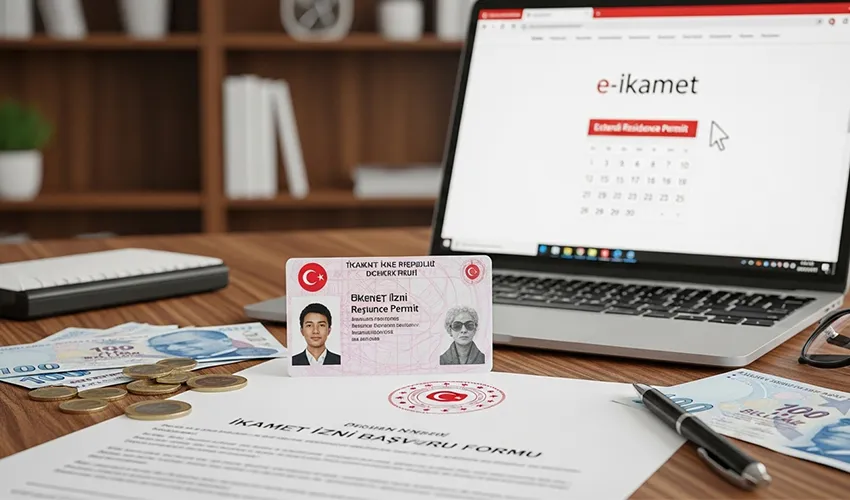
The increased rejection rate in 2025 is an undeniable reality. Understanding the rejection codes and their reasons is essential for every applicant.
The Most Common Reasons for Rejection (Article 32)
-
**Non-Compliance with Purpose (G-87 and Security Codes):** If the security system determines that the individual is a threat to public order (e.g., history of disputes, illegal work, or intelligence reports), a restriction code (**Tahdit Kodu**) like G-87 is placed on the file, and residency is rejected.
-
**Suspicion of Tourism Intent:** If the individual applies for a tourist renewal for the third or fourth year and cannot provide a travel plan or a reason to stay, the officer rejects the file based on their discretion.
-
**Deficiency in Housing Documents:** Submission of rental contracts notarized without the owner's presence or addresses located in banned districts.
-
**Insurance Issues:** Insurance policies not registered in the central system (SBM) or whose coverage dates do not fully overlap with the residency dates.
What to Do If Rejected? (The 10-Day Grace Period)
In case of application rejection:
-
**Notification of Ruling:** You are given a **Notification Form** (Tebligat Formu) where the reason for rejection is checked (usually Article 32 or 33).
-
**Exit Deadline:** You have **10 days** from the date of notification to leave Turkish territory. If you exit within these 10 days, you will not have an overstay penalty (**Vize İhlali**) or the penalty will be very low.
-
**Appeal (İtiraz):** You have the right to appeal to the administrative court within 60 days. However, given the high attorney fees and the length of the proceedings (sometimes up to 1 year), for tourist residencies, it is usually recommended that the individual leaves and returns after some time with a new visa or a different type of residency (such as property purchase).
Alternative Solutions for Staying in Turkey
Best Alternatives to Tourist Residency
Given the instability of tourist residency, applicants should consider changing their residency type:
-
**Property Residency (Taşınmaz Mal İkameti):** By purchasing property (even under $200,000 in open areas), the chance of obtaining residency is much higher than renting. However, property residency is also subject to the banned districts' restrictions.
-
**Student Residency (Öğrenci İkameti):** Enrolling in university language courses (TÖMER) or universities is one of the safest ways to extend legal presence.
-
**Investment and Company Establishment:** If you genuinely have economic activity, converting to a work or investment residency type is a safer route.
Conclusion
The renewal of Turkish tourist residency in 2025 is no longer a formality. This process has turned into a legal and financial test that requires full transparency, documented evidence, and strict compliance with new laws (such as UETS and notarization with the owner's presence). Iranian applicants must prudently avoid submitting any pro-forma documents, as the integrated migration system has gained a stronger capacity for monitoring and precise verification. Success in this path depends on complete readiness, early action (adhering to the 60-day window), and, if possible, shifting the strategy towards property or educational residency.